Seasonal Insights
Occasional reflections, sent by email.
SPRING 2026
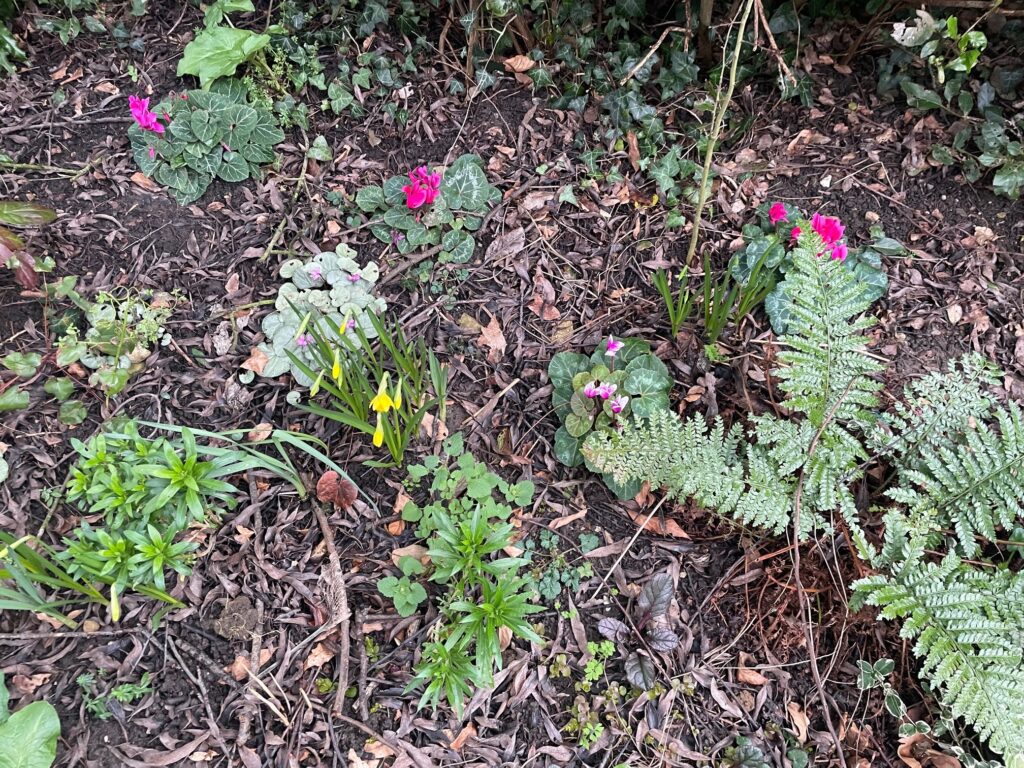
Late winter is the least trustworthy season in the garden. Days lengthen, light strengthens, and something in us responds almost automatically. We notice it first in ourselves — a restlessness, a readiness to begin — and only afterwards in the ground. But the garden does not move forward in a straight line. It hesitates. It advances and withdraws. It tests conditions, then retreats again.
This is the point at which enthusiasm most often runs ahead of understanding.
Soils are still cold, even when air temperatures rise. Roots remain slow while shoots are suddenly eager. A warm afternoon can suggest progress that the night quietly cancels. Frost lingers in shaded places long after it has vanished elsewhere. What looks like momentum is often just exposure.
In winter, the garden is honest. In spring, it can be misleading.
Some plants understand this better than we do. Snowdrops persist well into February not because they are fragile, but because they are precise. They flower, set seed, and withdraw with economy, before competition resumes. Hellebores continue to hold the ground, their flowers ageing visibly rather than collapsing. Pulmonarias emerge cautiously, leaves expanding only as conditions allow. They are not hurrying; they are responding.
Others are less measured. Growth can be fast and soft, especially after a mild spell. This is when damage is done — not by cold itself, but by sudden reversals. Plants pushed into activity too early are left exposed, their tissues unable to retreat as quickly as they advanced.
Much winter damage is not a failure of hardiness, but of timing.
For the gardener, this is a season that demands restraint. The urge to tidy, to cut back, to intervene decisively is strong. Bare soil looks like an invitation. But what appears unfinished is often functioning exactly as it should. Old stems still provide shelter. Leaf litter continues to moderate temperature and moisture. Disturbance now is rarely neutral.
This is also the season in which planning carries its greatest responsibility. Decisions made now are framed by optimism, but they will have to endure far beyond it. The temptation is to respond to the present moment — the light, the warmth, the sense of release — rather than to the longer arc of conditions that follow.
Planting at this threshold should be deliberate rather than enthusiastic. Not everything that can be planted should be. Not everything that survives will settle well. The question is not whether a plant will grow this year, but whether it will remain appropriate once the initial promise has faded.
Right plant, right place still applies. But right time matters just as much.
As winter loosens its hold, the structure revealed over the colder months begins to blur again. Branches soften with bud. Groundcover thickens. The garden’s underlying framework becomes less legible, and soon will be hidden altogether. This is the last moment to read it clearly — to notice where space holds, where lines work, where proportion feels resolved or uneasy.
Once growth accelerates, those lessons are easily lost.
The passage from winter into spring is not a clean handover. It is a negotiation. The garden does not flip a switch; it feels its way forward. Watching closely now — resisting the urge to hurry it — teaches more than any amount of activity later.
Spring will arrive regardless. The question is whether we arrive with it attentively, or merely relieved.
Names and knowing where you are
I am often accused — not entirely unfairly — of proselytising about botanical names. I won’t do that here, at least not overtly. Instead, two small stories about two plants, which illustrate opposite tendencies
The first concerns confusion.
According to a note in the Dorset archives, ‘Kiss-me-over-the-garden-gate’ is a local name for a pansy. This is almost certainly wrong. Elsewhere in the country, the name refers to Persicaria orientalis, a tall, obliging plant whose arching stems are perfectly capable of leaning over a fence or gate. The name makes sense in that context, even if the plant’s other common name — ‘Love-lies-a-bleeding’ — introduces a note of caution.
The confusion is not helped by the fact that Persicaria was until fairly recently folded into Polygonum, a group that also included Japanese knotweed and that aptly named menace, Mile-a-minute plant. The genus has since been revised, with some species moved again, this time into Bistorta and Koenigia. Sensible distinctions, botanically speaking — but hardly reassuring for anyone trying to keep their bearings
Common names drift. Scientific ones are supposed to anchor us. But even those anchors can be lifted and reset.
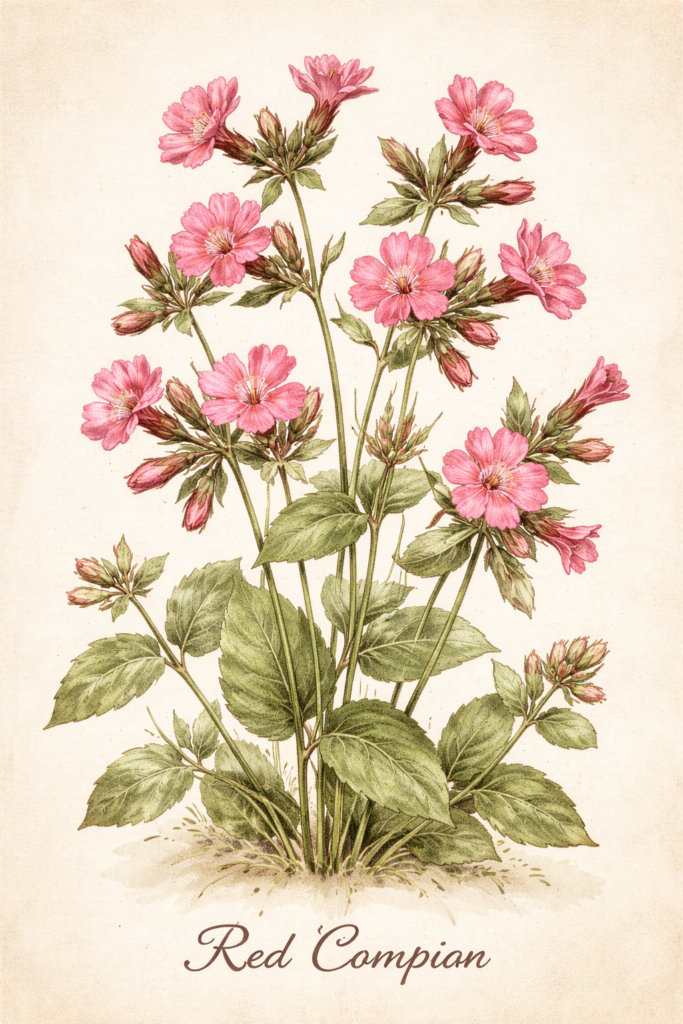
The opposite tendency is illustrated by red campion, Silene dioica.
Gerard, writing in his Herbal, describes its virtues with characteristic confidence:
“The weight of two drams of the seed of Wild Campion beaten to powder and drunk, doth purge choler by the stool, and it is good for them that are stung or bitten of any venomous beast.”
Across the country the plant has accumulated a remarkable assortment of local names: Ragged Jack, Scalded Apples, Johnny Woods, Poor Robin, Soldier’s Buttons, Mary’s Rose, Hare’s Eye, Gipsy Flower. In Somerset — and, oddly, also in parts of Essex and Suffolk — it becomes Red Jane or Red Wolf. Dorset, however, surpasses them all with Gramfer graygles, graygles being dialect for giggles.
None of this causes much trouble. The plant remains itself, wherever it grows, however it is addressed.
This is where botanical names earn their keep. They are not superior, and they are not poetic. But they are steady. They allow us to talk precisely while letting local language roam freely around them. With a botanical name, I know where I am — even when everyone else is calling the plant something different. However, if I ever hear someone speak of Gramfer Grayles, I shall definitely know the plant being mentioned, and I shall certainly know where I am.
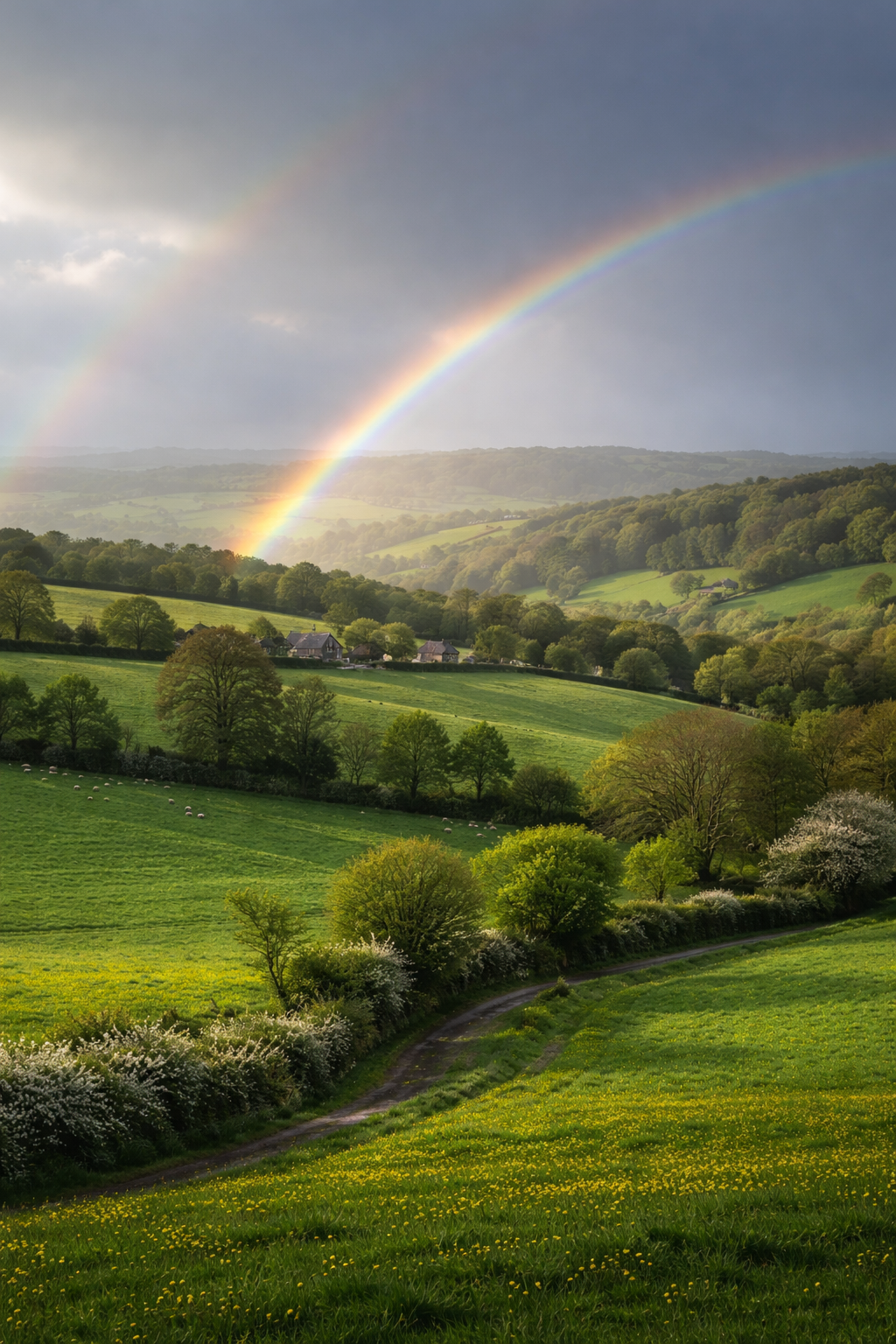
Of Dorset light, Somerset frost, and Devon rain
Some visitors to the Lost Gardens of Heligan or the Eden Project may come away with the impression that the further west we travel, the more accommodating the climate becomes. In south Devon, even in early spring, new potatoes may be lifted from the soil scarcely later than the arrival of Jersey Royals, while our comparatively mild conditions often allow growers to steal a march on the rest of the country by several weeks in the production of florists’ crops.
Yet such impressions, persuasive though they may be, conceal a more intricate reality. Within Dorset, Somerset, and Devon alike there exists remarkable variation — of light, exposure, soil, and temperature — each quietly shaping what prospers, what struggles, and what feels entirely at home. The principle of right plant, right place is not imposed upon these counties; it is written into them
New gardeners are often encouraged to look first at their surrounding gardens. What thrives next door, what repeatedly fails, what appears effortless — these become quiet guides to possibility. It is advice rooted less in horticultural theory than in observation. In much the same way, the landscapes of Dorset, Somerset, and Devon offer their own, far older counsel. Hedgerows, verges, pastures, and woodland edges reveal, without intention or design, the plants that have negotiated a durable truce with local conditions. The counties themselves, one might say, are already gardening.
I have long thought of Dorset as the most drought-sensitive of the three counties, a perception shaped perhaps as much by its light, open landscapes as by any strict meteorological measure. Hot, dry summers, once occasional, now seem increasingly characteristic, and no doubt Somerset and Devon will, in their different ways, feel similar pressures as seasons shift and patterns evolve.
Although Dorset possesses its share of heavy clay, Somerset and Devon appear, each for their own geological reasons, more frequently obliged to contend with soils of greater weight and persistence. The lightest ground, one might argue, belongs to the Dorset Downs, while among the heaviest are the Culm valleys of west Devon — landscapes where water, once received, is seldom hurried away.
Dorset possesses, to my eye at least, a distinctive brightness. Whether along the open sweep of the Downs or the exposed reaches of the Jurassic Coast, the sky seems to assume an unusual authority, its presence less frequently interrupted by enclosing landforms or lingering vapour. The light itself often carries a clarity — at times almost a sharpness — lending definition to colour and edge alike. It is perhaps no coincidence that plants of silvered leaf and restrained texture appear so naturally at ease within it. I have often noticed, too, that where a species offers both pale and deeper-toned forms, the lighter may appear curiously washed, while the darker seems to acquire an unexpected richness in the bright Dorset air.
Dorset’s brightness arises not from sunshine alone, but from the character of its landscapes. The Downs, with their long sightlines and clean horizons, offer a visual openness that grants unusual prominence to the sky. Chalk, pale and subtly reflective, lends an additional luminosity, reinforcing impressions of airiness and clarity. Where these open uplands meet the coastal atmosphere, the effect is heightened still further — onshore air movement often preserving a transparency of light less commonly encountered in the more moisture-laden counties to the west.
Such brightness seems to favour plants able to inhabit light without strain — those of silvered foliage, grey-green tonality, and aromatic character. Species such as Cistus, Lavandula, Santolina, or Tamarix appear not merely tolerant of Dorset conditions, but peculiarly attuned to them, their textures and colours responding with particular sympathy to the county’s lucid air.
Such brightness carries quiet consequences for the gardener. Colour behaves differently here; texture assumes greater importance. Pale-toned flowers may recede unexpectedly, while deeper hues gather intensity. Foliage, too, often speaks more eloquently than bloom, with silver, grey, and muted greens responding sympathetically to the county’s lucid air. Gardens conceived without regard for this clarity can feel curiously unsettled, as though designed for a softer sky.
Somerset
If Dorset is shaped by light, Somerset seems governed as much by air. Its landscapes, more folded and enclosed, possess a quiet tendency to gather and retain the atmosphere. Valleys, levels, and sheltered ground allow cold to settle with an unhurried persistence, so that frost, though seldom theatrical, becomes a familiar companion. It is not the severity of winter that defines Somerset, but its steadiness — the gentle, repeated reminders of temperature’s subtle authority.
On heavier Somerset soils, moisture is rarely absent for long, and this persistent dampness lends winter cold a particular character. Frost may arrive without drama yet linger beyond expectation, the ground slow to release the night’s chill. In such conditions, exuberance often flourishes in summer while winter exercises its quiet editorial control, favouring plants of resilience over those inclined toward flamboyance. Structure, resilience, and seasonal patience frequently prove the most reliable companions.
On the Levels, Somerset’s affinity with moisture assumes its most expansive form. The winter landscape, at times, appears less grounded than reflected, fields yielding temporarily to the sky’s doubled image. Such scenes do not simply illustrate weather, but reveal the underlying disposition of the land — a place where water is never entirely absent, merely shifting in emphasis from season to season.
For the garden designer, Somerset is the county of heavy soils, frost pockets, and valley microclimates. Drainage remains both the first and last consideration. The landscape’s tendencies toward enclosure, moisture, and lingering cold impose their own disciplines. Early exuberance is not always rewarded, nor is delicacy consistently indulged. Some plants will disappoint repeatedly. Structure, resilience, and seasonal patience frequently prove more reliable companions than precocity. Yet within these constraints lies opportunity, for few landscapes sustain lushness with such quiet authority once warmth fully returns. This is a landscape that holds water — and shapes its gardens accordingly.
For the garden designer, Somerset is the county of heavy clay soils, frost pockets and valley micro-climates. Drainage is first and last of its gardens’ needs. Somerset’s tendencies toward enclosure, moisture, and lingering cold impose their own disciplines. Early exuberance is not always rewarded, nor is delicacy consistently indulged. Some plants will dispappoint repeatedly. Structure, resilience, and seasonal patience frequently prove more reliable companions than precocity. Yet within these constraints lies opportunity, for few landscapes support lushness with such generosity once warmth fully returns. This is a landscape that holds gathered water. This is the county where hostas, ferns, and hydrangeas feel entirely at home, their presence emerging softly through fog, frost, and the shifting memory of water.
Devon
Devon, with its greater number and scale of rivers, often appears less inclined to retain water than to release it. Where Somerset gathers and Dorset drains, Devon moves. This ceaseless circulation lends the county a remarkable diversity of landscape expression. The benign belt of the south coast differs profoundly from the Atlantic-exposed north, while the intervening countryside — softened by rainfall and moderated air — frequently encourages a luxuriance difficult to sustain elsewhere. These long-familiar patterns now unfold within the broader uncertainties of a changing climate, whose influence is beginning to reshape even the county’s most characteristic tendencies.
The mild advantage of the South Devon coast sets it conspicuously apart not only from the county’s interior, but from much of the wider region. In towns such as Torquay, Cordyline australis has become almost emblematic, while genuinely tender presences — the Mediterranean dwarf fan palm or Phoenix canariensis — find conditions of surprising accommodation. Such scenes stand in gentle contrast to inland Devon’s more enclosed mosaic of woodland and field, where acid soils and softened light favour plants of an altogether different persuasion, not least the enduring enthusiasm of rhododendrons.
Growth here may be vigorous, foliage expansive, colours deeply saturated. Yet such generosity carries its own negotiations: shelter from wind, the management of exuberance, and the quiet vigilance demanded by moisture’s persistence. Devon offers scope in abundance, but rarely indulgence. Design, however ambitious, must remain attentive to the temper of place.
Across Dorset’s clarity, Somerset’s stillness, and Devon’s restless abundance, one becomes aware that gardening is never practiced upon neutral ground. Each landscape, through its light, its air, its water, exerts a quiet but persistent influence, encouraging certain gestures while discouraging others. Success lies not in resistance, but in sympathy — the slow understanding that real gardens, like the plants within them, are shaped by the places they inhabit.