
Seasonal Insights
Occasional reflections, sent by email.
AUTUMN 2026
Reflections on drought, autumn colour, and the garden’s response to a changing season.
About drought
Many people take it that if there has been no rain for thirty days, we have a drought on our hands. That’s actually close to the meteorological definition of drought. But there are other kinds of drought …
Agricultural drought concerns water available to roots; hydrological drought relates to rivers, reservoirs and groundwater; ecological drought is about damage to natural systems. All these develop and recover, or not, at different speeds. And thirty rainless days in the West Country mean something quite different from thirty rainless days in East Anglia, because normal rainfall, soils, and vegetation differ.
A drought does not end when rain returns
Rainfall and drought are not opposites. A garden can receive occasional heavy rain and remain functionally dry because much of that rain runs off, evaporates, or fails to penetrate deeply enough to restore the root zone. A wet week may green the surface and revive shallow-rooted plants while deeper soil, aquifers, rivers and reservoirs remain depleted. Conversely, a heavy clay garden may become sticky or waterlogged while the region stays officially in drought.
Autumn rainfall totals are misleading
Annual rainfall totals tell us surprisingly little about whether a particular plant is short of water. Soil depth, texture, organic matter, compaction and rooting depth determine how much useful water is actually available.
The past year saw an exceptionally wet winter followed within months by record or near-record soil dryness. What matters to plants is when rain falls, how intensely it falls, how deeply it infiltrates and how much is subsequently lost through evaporation and transpiration.
The soil is the reservoir that matters to plants
Clay complicates the picture. It can hold a great deal of water, but not all of it is available to plants. As clay dries, water becomes progressively more tightly held; cracking can then allow subsequent rain to disappear down fissures rather than evenly rewet the surface rooting zone.
Heat intensifies drought regardless of any further reduction in rainfall
Hotter air increases evaporative demand. This means that rainfall that might once have been adequate can now produce severe plant-water stress. A dry spring followed by a hot summer is much more serious because the soil reservoir may never have been properly replenished beforehand. In other words the condition of the garden in July may depend partly on how thoroughly the soil profile was recharged between October and March. What’s more, we must link the season just experienced not just with the winter and spring before it, but with the winter ahead too.
Plant demand is only half the equation
Drought is not solely about how much water enters the soil; it is also about how rapidly water leaves it. Temperature, sunshine, wind and humidity all affect transpiration. The same rainfall can therefore support plants well in one summer and be inadequate in another.
The West Country problem is not merely increasing dryness
Gardens must increasingly tolerate rapid movement between winter saturation and summer deficit. This makes some conventional ‘drought-tolerant’ recommendations unsuitable for heavy Dorset clay or low-lying Somerset ground: plants must often tolerate both dry summers and wet roots in winter.
Different plants respond to drought in different ways. They may:
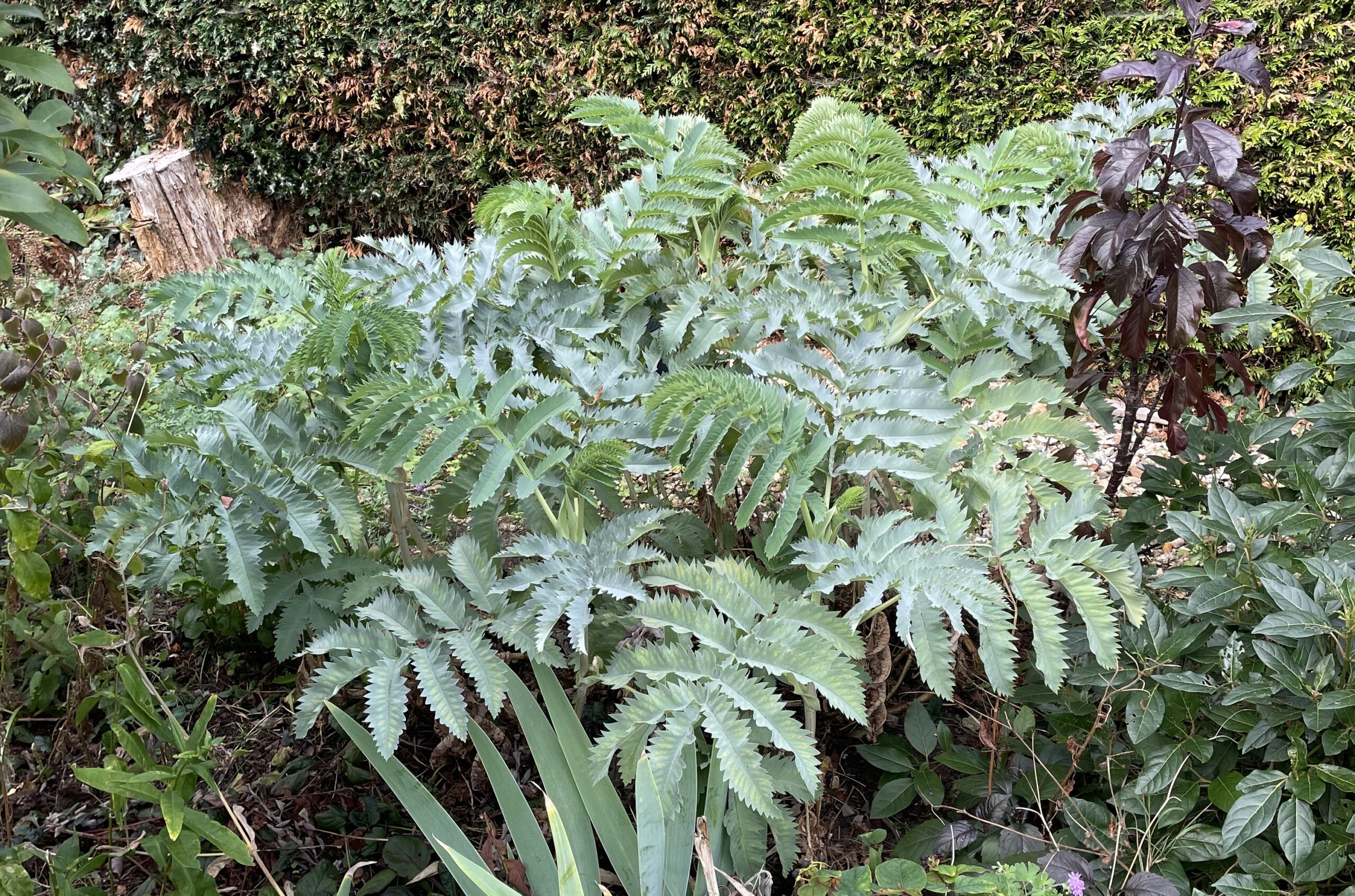
- Continue growing apparently unaffected (Melianthus major)
- Wilt temporarily to reduce water loss (Rhododendrons)
- Shed leaves prematurely (Cercidiphyllum japonicum)
- Stop flowering or setting seed (repeat-flowering roses)
- Complete flowering and accelerate reproduction (many annuals)
- Become dormant above ground (Acanthus mollis)
- Die back but retain viable roots or crowns (Paeonia delavayi)
- Recover rapidly after rain (lawn grass, weeds)
- Appear to recover, then fail during winter or the following spring (Birch, Beech, newly planted trees and shrubs, some rhododendrons)
Much more research is needed on plants’ drought responses. We can observe and record which of the above points applies to which plants, and whether that varies from one year to another or is consistent. And because the picture varies so between one garden and another, our research as gardeners is going to be just as useful as official reports from the RHS or the Met Office or wherever, if not more so.
Survival and thriving are different standards
A plant that remains alive is not necessarily a good garden plant under drought. For design purposes, appearance, flowering, foliage retention, ecological usefulness and speed of recovery may matter as much as survival. There are only a few herbaceous plants that yield to drought gracefully, like Allium, Eryngium, or Persicaria affinis ‘Dimity’ among groundcovers.
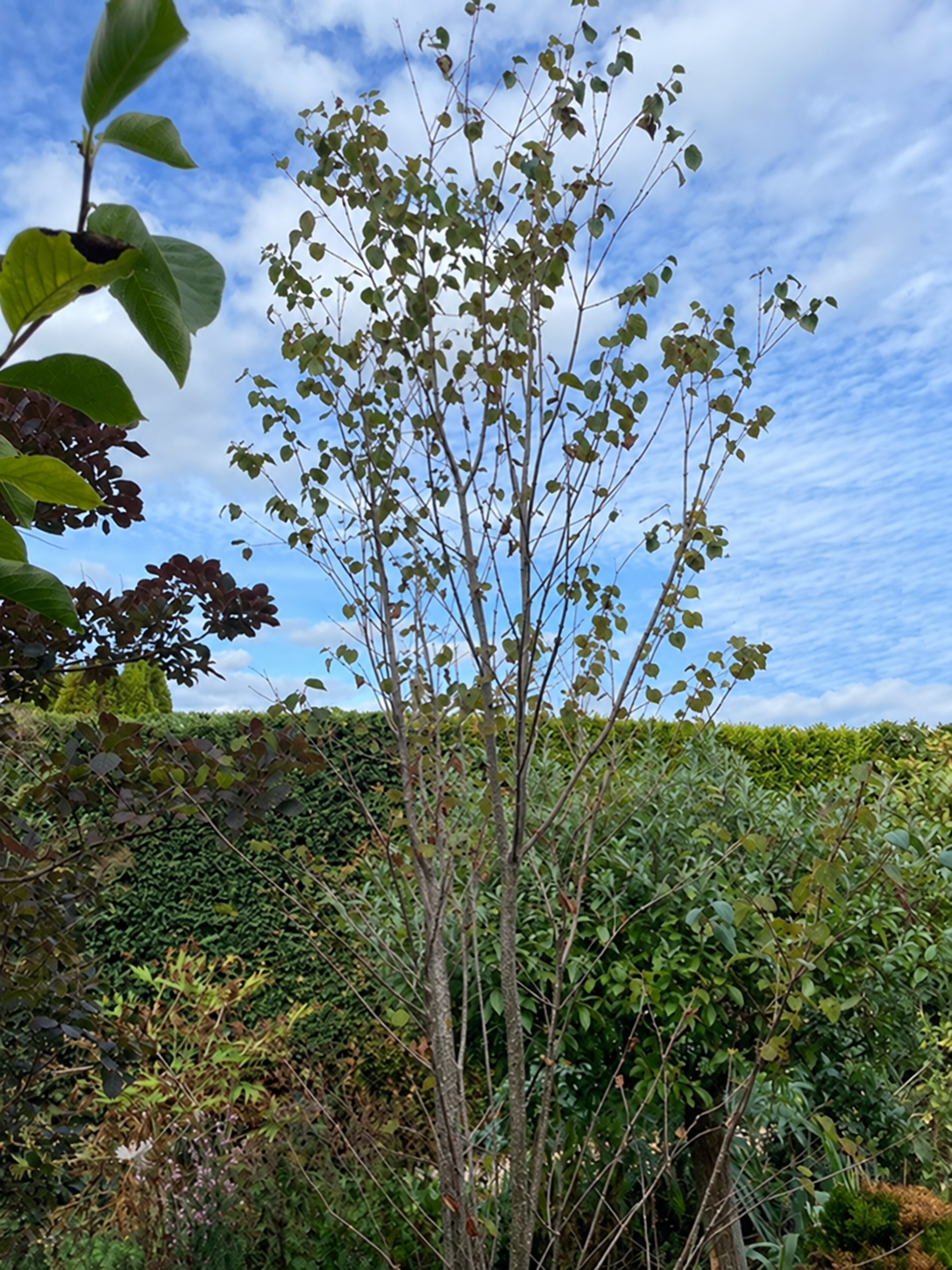
Melianthus major passed the last winter remarkably well, unfazed by the shock of severe frosts that occurred in December, but as normal needed cutting down eventually. It responded to February’s extreme rainfall, and remained as handsome as always throughout the summer. Right now in late September it has responded to some refreshing rain we have had, with vigorous new foliage. By contrast the lovely Cercidiphyllum japonicum (Katsura) conserved itself last autumn and this, by shedding leaves early. Both these are survivors but by applying completely different strategies.
Plants experience drought differently.
Shallow-rooted herbaceous plants may suffer while deep-rooted plants continue normally. The same principle applies to freshly planted shrubs and trees, to annuals, and to plants in pots. A recently planted shrub with roots confined to a small planting hole can be in severe drought while an established shrub beside it remains perfectly comfortable. Recently planted shrubs and trees are always going to need water for their first year, at least until they have managed to put their roots down deep enough to fend for themselves. And of course, gardens create their own microclimates. Walls, hedges, mature trees, slopes and paving alter rainfall interception, shade, wind and competition for moisture. “My garden has had 20 mm of rain” does not mean every square metre has received 20 mm of useful water. This also explains why providing plants with a frequent sprinkle is only effective with annuals, and no substitute for a thorough watering less frequently.
Drought resistance is not the same as drought tolerance
Some plants avoid drought through deep roots or summer dormancy; some tolerate dehydration; others merely survive it badly. Survival alone is not necessarily a satisfactory criterion for garden design.
Repeated drought changes a garden
The important issue is not always whether a plant dies in one exceptional summer. Several dry summers can weaken growth, reduce flowering, make plants more vulnerable to pests or disease, and gradually alter which plants dominate. And if each successive summer is preceded by a winter which only partly relieved the drought, the cumulative effect is worse still.
- Watering can disguise poor plant choice. Irrigation may keep unsuitable planting alive, but it does not necessarily make the planting well adapted to its site. ‘Right plant, right place ’ always applies.
- Drought-smart gardening is not xeriscaping. The object is not to create a dry garden, but to create a garden able to cope intelligently with increasingly dry and erratic summers while remaining suited to a climate in which winter may still be very wet.
- The objective is resilience rather than invulnerability. A resilient border can look tired in an exceptional August and recover strongly when conditions change. Expecting uninterrupted perfection may itself be part of the misunderstanding.
It doesn’t seem long ago that we all knew that what goes around comes around, that rainfall over four seasons would turn out eventually to be broadly balanced. That cannot be assumed any more. We now must expect the unexpected, and the plants that cope with that are going to be the winners.
In praise of brown
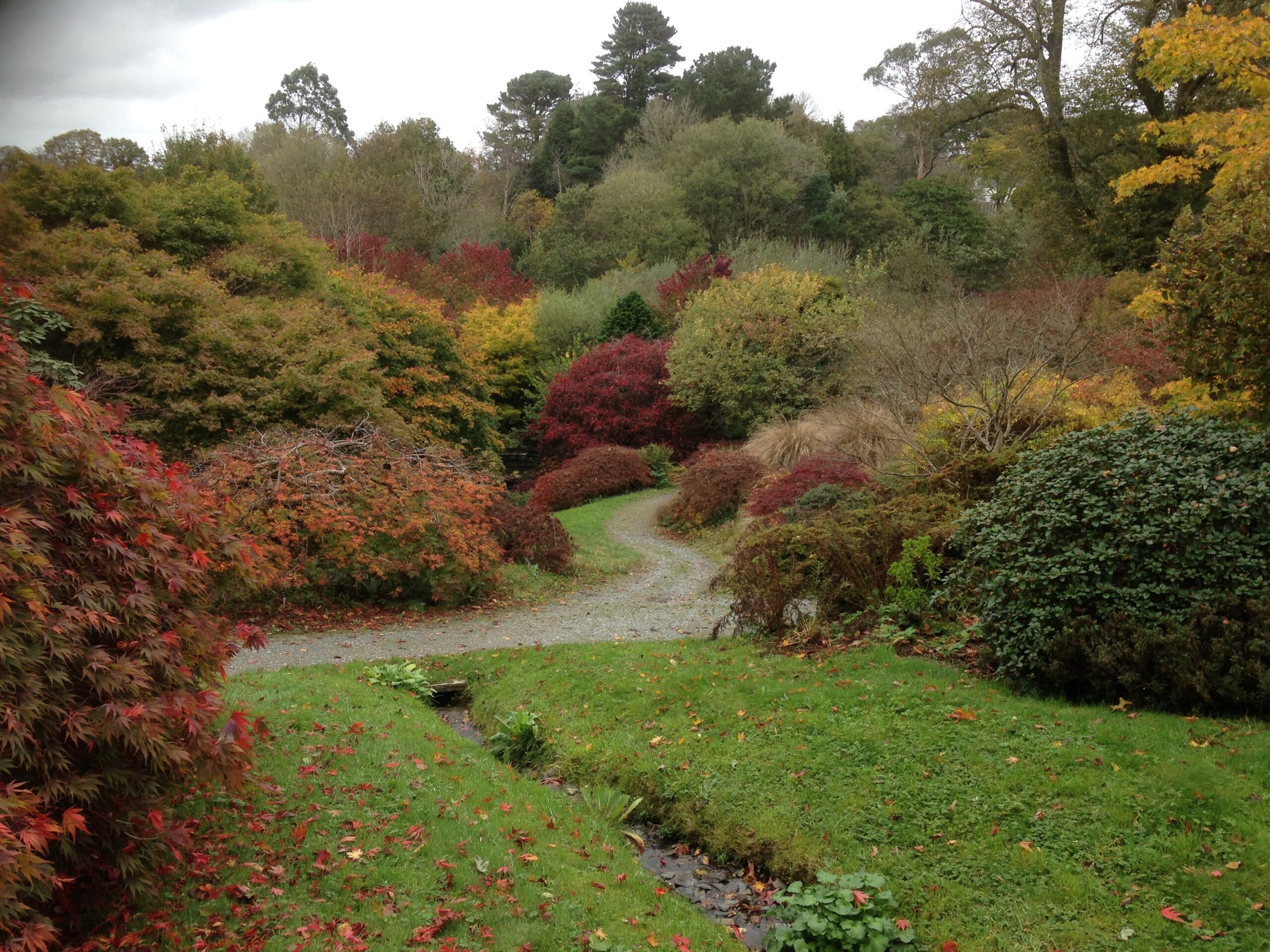 The Garden House (near Yelverton) in its autumn colours
Brown has had a bad press in gardens. It is not one colour, and certainly not necessarily the colour of death — rather soil,seedheads,bark, decay, compost, leaf mould, peat-darkness, weathered wood, winter stems — the colour of return, preparation and foundation. In a West Country garden it may include the colour of mulch, weathered stone, and thatch, as well as the broader landscape beyond the garden. The character of brown is warmth and welcome.
Connecting the colour brown with excitement may seem odd, but when I was a child in the fifties, I remember going off to Devon for our summer holiday and like all children, kept asking if we were nearly there; I remember being told that when I could see soil turning from brown to red-brown, we would be getting near our destination. And it was so of course. Adding the gorgeous rich red-brown colour of Red Ruby Devon cattle which I hadn’t encountered before, I learnt then how exciting the colour brown can be. It was the excitement of anticipation, and entirely appropriate for soil as the vital foundation of life: brown soil, teeming with microscopic organisms and nutrients and microrrhizal fungi. It is host to the plants that provide us with food, oxygen, and countless other resources. And gardening. The West Country climate has allowed the formation of rich brown soils, and the fact that the West Country doesn’t lend itself as readily to soil degradation and erosion as the rest of the country has allowed it to keep it.
The fact is that brown means quite different things in August and November. In August, brown grass may signify stress, drought, and premature senescence. This year more than ever before, people have been exhorted to not water their lawns, on the basis that the lawns are sure to green up again when eventually it rains. Sure enough, most lawns in the West Country turned from straw colour to green in a matter of days following a few rain showers this September.
The brown of the earth
Brown often means soil exposed by cultivation, molehills, paths, banks and newly dug ground or drainage ditches cleared to cope with expected winter rains. On heavy clay it may be chocolate-dark when newly turned and much paler when dry. Unlike green, this is literally the substance from which the garden emerges.
Brown after rain
Perhaps particularly in the West Country, wet bark, damp stone, timber, fallen leaves, and the earth itself deepen dramatically in colour. Brown becomes richer rather than duller. Against moss, ferns, and wet evergreen foliage it can be exceptionally beautiful. A fernery is about the only garden feature in which I leave the earth uncovered until it receives a (brown) mulch. Brown earth can seem friendly and comforting and interesting.
Brown as the colour of autumn’s second act
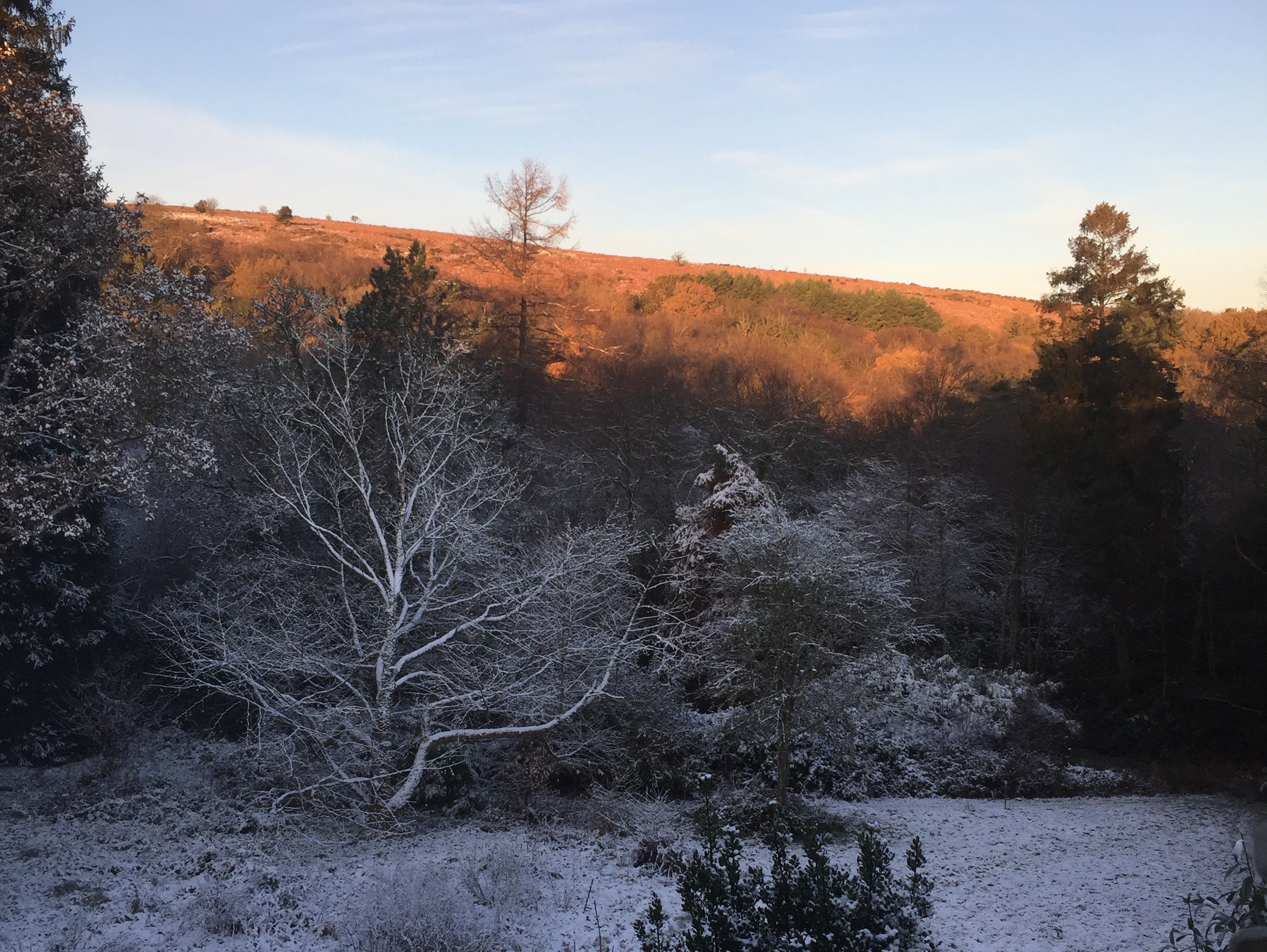
There is the familiar blaze of yellow, orange and red, but afterwards comes another stage: beech leaves turning tawny, oak leaves going russet, grasses bleaching to biscuit and bronze, hydrangea flowers fading, seedheads darkening. The garden does not jump directly from autumn colour to winter. The appearance of Dartmoor after the bracken has completed its turn from green to brown is dramatic and visible for miles.
The standing dead
For the most part brown emerges in nature rather than being planned. But there are plants which acquire shapes and colours that develop and become more interesting once flowering has finished. I’m thinking Phlomis, Eryngium, Echinops, Hylotelephium, fennel, teasel, asters and many grasses. The RHS now positively encourages retaining many seedheads for winter beauty and of course wildlife benefit. Beth Chatto Gardens similarly leaves much skeletal structure standing until it begins to collapse.
Grasses — where brown becomes light
Straw, biscuit, buff, bronze, tobacco and russet are technically browns, but sunlight changes them entirely. For Beth Chatto, the ageing flowerheads of grasses provided form, movement, and translucency, particularly when backlit by the autumn sun. This is so valuable for us in the West Country, since there are a good many grasses that perform in autumn drought and winter wet alike.
Bark and wood
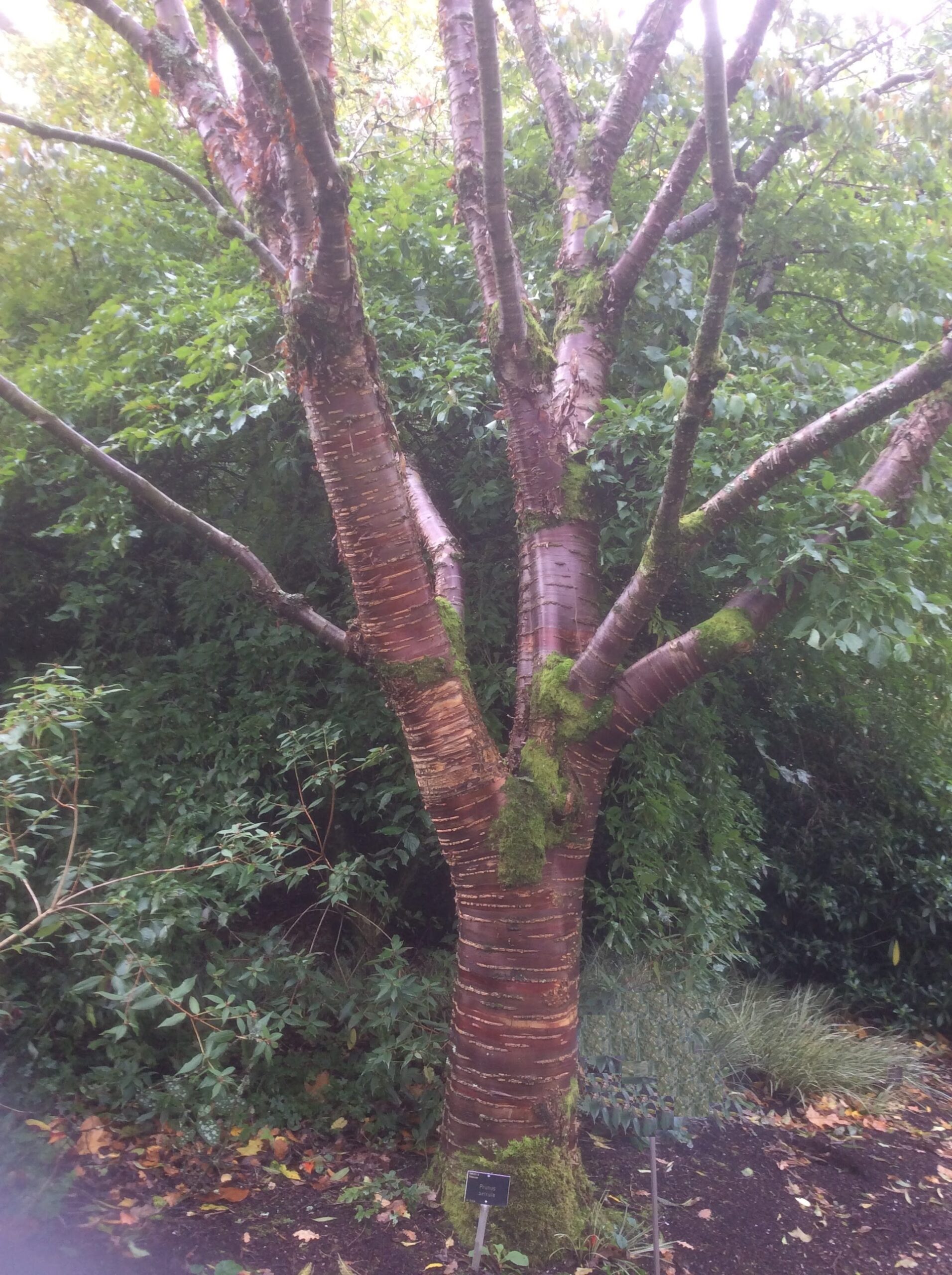
Brown bark can be smooth, polished, scaly, fissured, peeling, grey-brown, red-brown or almost black. Its texture becomes as important as hue once the leaves have gone. The smooth, polished coppery brown bark of Prunus serrula is unforgettable. Acer griseum has cinnamon-red, peeling, paper-like flakes that exfoliate continuously to reveal smooth orange-red wood. So many trees have bark that can seem sombre, even dull, but lit by the sun immediately become vibrant and exciting, like Wellingtonia (Sequoia giganteum), or mature Scots Pine (Pinus sylvestris).
Brown and decay
Decomposition is one of the processes by which the garden renews itself. A rotting leaf is not failed foliage; it is becoming soil. Here brown is a transitional colour. Gardeners tend to regard decay as something to clear away. I suppose it is a bit eccentric to find beauty in a set of well kept compost bins, but there is something exciting and full of promise about it, and come to that, so there is with a well-curated manure heap!
Brown and wildlife
Leaving stems, hollow stalks, seedheads, and leaf litter isn’t merely picturesque; they offer seeds, overwintering sites, and shelter for local wildllife. It’s a vital micro-ecosystem, for beneficial insects like ladybirds, and moth pupae, beetles, spiders, and amphibians.
Brown as background
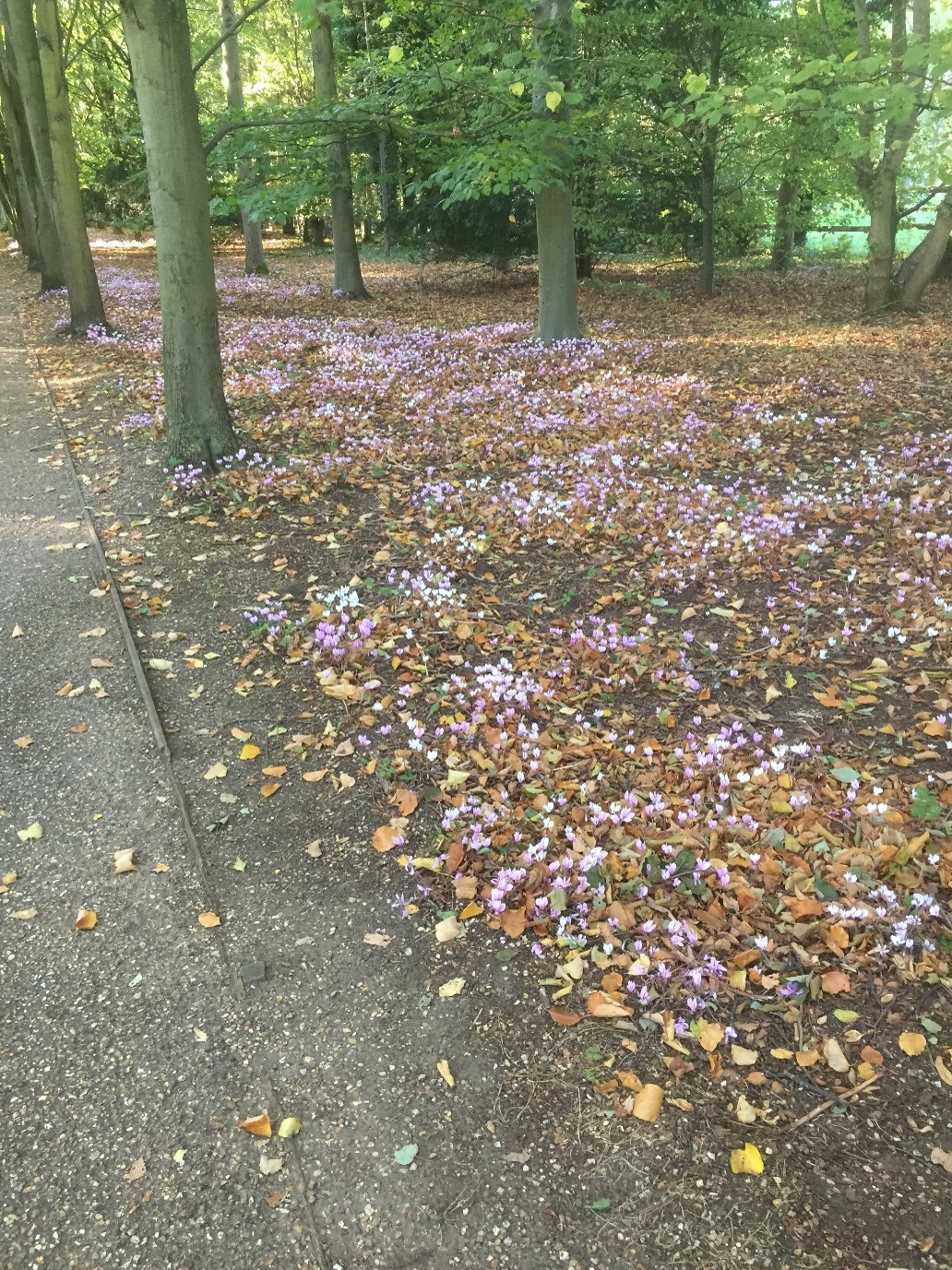
Flowers become more noticeable because of the browns around them. Cyclamen, snowdrop, crocus, colchicum, all look far more intense amongst browns than they would against the universal green of June. I like making a fernery that combines ferns and hostas as equal partners. Both benefit from their lush contrast with brown earth or mulch. Brown is the warm and welcoming colour, more so than green.
Brown in the wider West Country landscape
Ploughed fields, hedge banks, bracken, dead grasses, bare hedges and woodland floors bring the garden into relationship with the countryside. A garden dominated by polished evergreen foliage can look oddly detached from that landscape in November.
There is good brown and bad brown
Sooner or later a hosta’s leaves, collapsed after frost, (assuming they haven’t been eaten by slugs), may need removing. The same may apply to sodden day lily foliage, or mildew-blackened leaves. But remember the tawny Molinia, the seedheads of Phlomis, the papery remains of hydrangea flowers, or a stand of dried fennel; all these can be worth keeping. Beth Chatto Gardens makes essentially this distinction themselves: some plants die beautifully and are left standing; others don’t and are cut down. This is a much more sensible policy than the rather fashionable injunction that everything must be left standing through the winter. Discrimination is still gardening.
The urge to tidy
The old autumn habit among gardeners was to tidy everything, chop down the herbaceous border, and have a bonfire. Nowadays we are enjoined not to. The RHS inclines towards a more laissez-faire approach, encouraging us to leave stems, seedheads and fallen material where they can provide winter structure and shelter for wildlife. I believe this compromise is the answer, but there is a peculiar moment in autumn (round about Michaelmas Day I think) when perfectly sensible people suddenly feel that everything must be cut down, swept up and made neat. This urge to tidy is often stronger than the horticultural reason for doing so.
It may even be that some gardeners of advancing years embrace this newer advice with particular enthusiasm, welcoming the excuse not to tidy and the increasingly shorter days as a blessing to aching limbs.
I have a friend with a big garden who had his gardener spend many hours raking the lawns to collect all the fallen leaves, mainly beech, and burn them! It still pains me to think of such a valuable resource being wasted. My friend was judging the garden by its appearance rather than reading what was happening in it, and I think his gardener should have suggested a better use for the leaves.
Tidiness as a human response to autumn
Browning and bent stems, fallen leaves, and dying foliage can look like disorder after the abundance of summer. And these days those features may have been in place for months rather than weeks, because of our drought-stricken summers. Cutting everything down does seem to restore visible control.
However, the garden is not actually finished. Seed heads, stems, grasses and dying foliage remain part of the garden through autumn and winter if they are allowed to. Some even become more visually important once flowers have disappeared, and these same plants provide shelter and sustenance for many birds and insects and other wildlife. A visibly controlled and excessively tidy garden removes much of that habitat.
Fallen or collapsed and old growth can shelter crowns, soften the effect of frost and rain, and gradually return organic matter to the soil. For instance the enormous leaves of Gunnera manicata, collapsed over the plant’s crown, can make all the difference in protecting the plant against winter. The leaves of Osmunda regalis behave in the same way, although it is hardy down to minus 20º C.
Selective tidying is a better rule than leaving everything alone
Diseased foliage may need removing; vigorous plants may set seed where they are not wanted; weeds will persist; paths mustn’t simply disappear beneath leaves; and some plants collapse into an unattractive mess.
Selective tidying is the more interesting approach. Remove what is genuinely troublesome while leaving what still has structure, beauty or usefulness.
Fallen leaves
Raking up accumulated fallen leaves from border or lawn is a good idea, putting them somewhere to break down and form beautiful brown leaf mould a year later.
Planting
Roses are best planted in autumn, bare-rooted, as well as other deciduous shrubs, and trees. I like to plant herbaceous plants also in the autumn, in the hope that they can become established in good time. Lifting, dividing, and planting herbaceous plants is good to do in the autumn. Bulbs and corms are available from September onwards, and it is satisfying to have got them planted in good time. Wallflowers also need planting, with their tops nipped out to encourage strong spreading plants.
Pruning
Pruning overgrown shrubs and hedges is much better done when they are dormant. The DEADDUCK* approach for pruning apple trees works well with most trees and shrubs.
Mulching
In the West Country, mulching is better done in early spring in many places rather than autumn. We want the winter rain to replenish the aquifers, and the mulch, whatever it is, applied to prevent all that water escaping or evaporating. It all depends on what the weather throws at us.
Taking stock
Autumn and winter are the season when taking stock makes the most sense and is actually easiest. It is good to note which plants succeeded and which failed. Photographs and notes will be invaluable. Checking soil health is easily done, by observing where water pools or where soil dried out too fast in summer extremes.
The most important tasks
The traditional autumn tidy-up is often less about what the garden needs than about what makes the gardener feel that the year has been brought properly to an end. Indeed one reason people cut gardens down is precisely because they have been taught to regard brown as the colour of decay rather than another stage in the life and appearance of a plant. A Phlomis, Eryngium, grass, hydrangea head or standing perennial may have lost its summer colour without having lost its value.
Instead, we should read what is happening in the garden and listen to what it is telling us. Autumn tidying, to whatever extent it is done, determines what the garden will look like in winter. If everything is cut to ground level in October, one has effectively designed a bare winter garden. It’s a pity to end up like that, when actually autumn tidying asks us to reconsider when a plant has really finished contributing to the gardens. There is plenty of worthwhile work instead that beckons in most gardens in late autumn, winter, and early spring.
* The mnemonic is this:
D – Dead wood
E – Eaten or damaged by pests
A – Ailing or diseased branches
D – Dying limbs showing poor growth
D – Damaged from weather or mechanical injury
U – Ugly crossing or rubbing branches
C – Crowded areas blocking airflow and ligh0t
K – Kinky or awkward growth that disrupts shape. Also stands for Quarter, meaning don’t remove more than 25% of the plant in any one year, to minimise risk to the overall health of the subject.
↩
Autumn is not the end
The days are shortening, flowers are fading, leaves are falling; in short, things seem to be closing down.
Many years ago, when I lived in the north-west of Scotland, the shortening days were taken seriously. As autumn advanced, daylight became noticeably scarce, and people spoke quite matter-of-factly about the melancholy effect this could have on spirits. Crofters, whose working lives were particularly governed by daylight and weather, seemed especially conscious of it.
Gardeners farther south experience nothing quite so extreme, but I wonder whether something of the same feeling lies behind the sadness some people associate with autumn. The days shorten at precisely the moment when the garden appears to be withdrawing as well.
In the garden there is gradually less light for the gardener and less visible life in the garden. The light truly is diminishing; the garden genuinely is losing much of its summer display; the effect is greater if the summer passed has been ruled by drought, but it does not follow that the garden has finished. Underground, it is doing almost the opposite. If we read autumn only with the eye, we miss what is actually happening unseen, which is preparation and progress.
Why do we assume that what we can no longer see has ceased to matter? There is something very old and understandable about associating diminishing light with diminishing life. The garden reinforces it because so much that gave pleasure in June is visibly disappearing at the very same time. We must remember that so much unseen is going on underground and within plants below the surface. What is happening is a quieter succession of biological processes concerned with survival and renewal. Before the top growth dies completely, the plant pulls sugars, carbohydrates, and nutrients out of its green leaves and stems, moving them down into the root system. They become a reservoir of energy to fuel new growth next spring. Meanwhile even when the plant becomes dormant, it can still absorb tiny amounts of oxygen from the soil, and release tiny amounts of carbon dioxide just to maintain cell health. While the soil remains warm enough, roots may continue to grow and the plant remains part of the living community of fungi and microorganisms around them.
The disappearance of swallows and swifts for example, may be seen not as final, but as a beginning; they are setting off on a voyage which the young among them have never made before, enabling their return to the same spot next year, all being well. This concept of continuity is really significant.
Robins are unusual among familiar garden birds in that both sexes sing in autumn and winter, largely in defence of feeding territories. Their autumn song has a different character from the vigorous breeding song of spring and is sometimes described as melancholy. I have listened carefully to it, and I suspect that the melancholy lies in the listener rather than in the robin. But the autumn song certainly has a purpose.
A number of plants contradict the idea of autumn meaning decline — autumn is when they get going. (Think of Colchicum autumnale, or Nerine bowdenii, or Helleborus niger. Cyclamen hederifolium leads the way with its emergence in very early autumn, followed later by C. coum winter to defy the idea that autumn is the end. There is the winter jasmine, Jasminium nudiflorum, preparing in autumn for its lavish display of yellow flowers in climbing form in winter and early spring; there is the rare Narcissus ‘Cedric Morris’ which Sir Cedric Morris collected in Spain flowering in Autumn; and importantly there is Iris unguicularis which proves the point emphatically, by flowering a little in late autumn, a little more in early winter, finishing with a full display in early spring.
Bulbs and corms go into the ground in autumn ideally, carrying next spring invisibly within them. They have time to spend the winter developing their roots, again helped by the warmth of the autumn soil. Some spring bulbs also require a period of winter cold as part of the process that prepares them for growth and flowering. All this development also takes place underground and out of sight. Even edible crops can be sown in autumn for later cropping, whether they be agricultural such as winter wheat or barley, or horticultural, such as winter lettuce and spinach for sowing in autumn or beans and peas for sowing later to overwinter for an early crop next year. There is all the evidence anyone could ask for to show that autumn is just a stage in the cycle of the garden in all its manifold aspects, tinged with sadness perhaps, but only from a human perspective. Plants meanwhile are getting on with life.
The soil remains warm in autumn, especially following summers like the last three. Its warmth speeds up metabolic processes, thereby stimulating root expansion and lengthening. It does all this unseen of course, below the soil surface.
Autumn rain restores moisture after summer drought, maybe not completely, but enough to help the stronger plants that have been ailing. It makes autumn the best planting season for trees, shrubs, and many perennials; certainly for bare-rooted roses, which are said to establish more quickly than the potted roses, and of course cost less.
Fallen leaves are not merely debris. The fall of leaves is not failure but deliberate. In a nutshell, a tree breaks down chlorophyll (leaves turning colour) and reabsorbs nutrients, storing them in twigs and branches for spring. And, autumn’s shorter days and cooler temperatures cause a band of cells (the abscission layer) to form at the base of each stem, cutting off the flow of water and nutrients until the leaf falls off. That action is just as phenomenal as germination; like germination, it’s preparation. Unlike bulb development, it is visible, (and its progress even visible from space, in the forests of north east America).
Seedheads contain the next generation. They don’t necessarily stop when they are formed. They may prepare, by making themselves available for dispersal by wind or by birds and insects. The dispersal activity continues through winter until it is complete.
Many plants form next season’s buds long before winter. Rhododendrons, for example, begin forming their flower buds in late summer, and I have learnt to be careful when deadheading the spent flowers not to damage the new growth below.
There is also a widely held tenet that the garden only needs attention in the summer months. There really is plenty to do during the winter months, and it tends to be proactive. It may well include making plans for spring, deciding on seeds to get, sowing and planting, moving plants, and dealing with hedges and fences.
Autumn is not the garden dying. It is the garden changing where its life is being held. It is the season of preparation.
We do not have to wait for spring for the garden to begin again. It has already begun.