
Control in the garden is an illusion. In this environment, the owner/gardener may plan, specify, or arrange, or propose relationships between plants, but the garden itself decides whether they endure. Even the most disciplined garden is still a negotiation with biology and weather, not a victory over them. Nature holds the cards. In other words, the successful plant community we call a garden is a partnership of three: owner, gardener/designer, and nature. The first two can be a single person, but the third doesn’t care, and is going to win anyway.
Painting and gardening are deeply intertwined. Whilst a painter mixes colours and applies them to paper or paint to capture light and texture, a gardener uses plants, earth, and seasonal change to paint with nature. The two disciplines are the same: the garden just has earth instead of canvas, and living plants instead of pigments. Plus three other elements: the fact that the garden has three dimensions rather than two, the fact that the medium applied is alive and will grow, and the overarching element of time. The painting/gardening milestone is surely Claude Monet’s garden at Giverny, with its water lilies and Japanese bridge; Turner’s influence on Gertrude Jekyll as an artist arose a little later, and painting and gardening were firmly linked from then onwards.
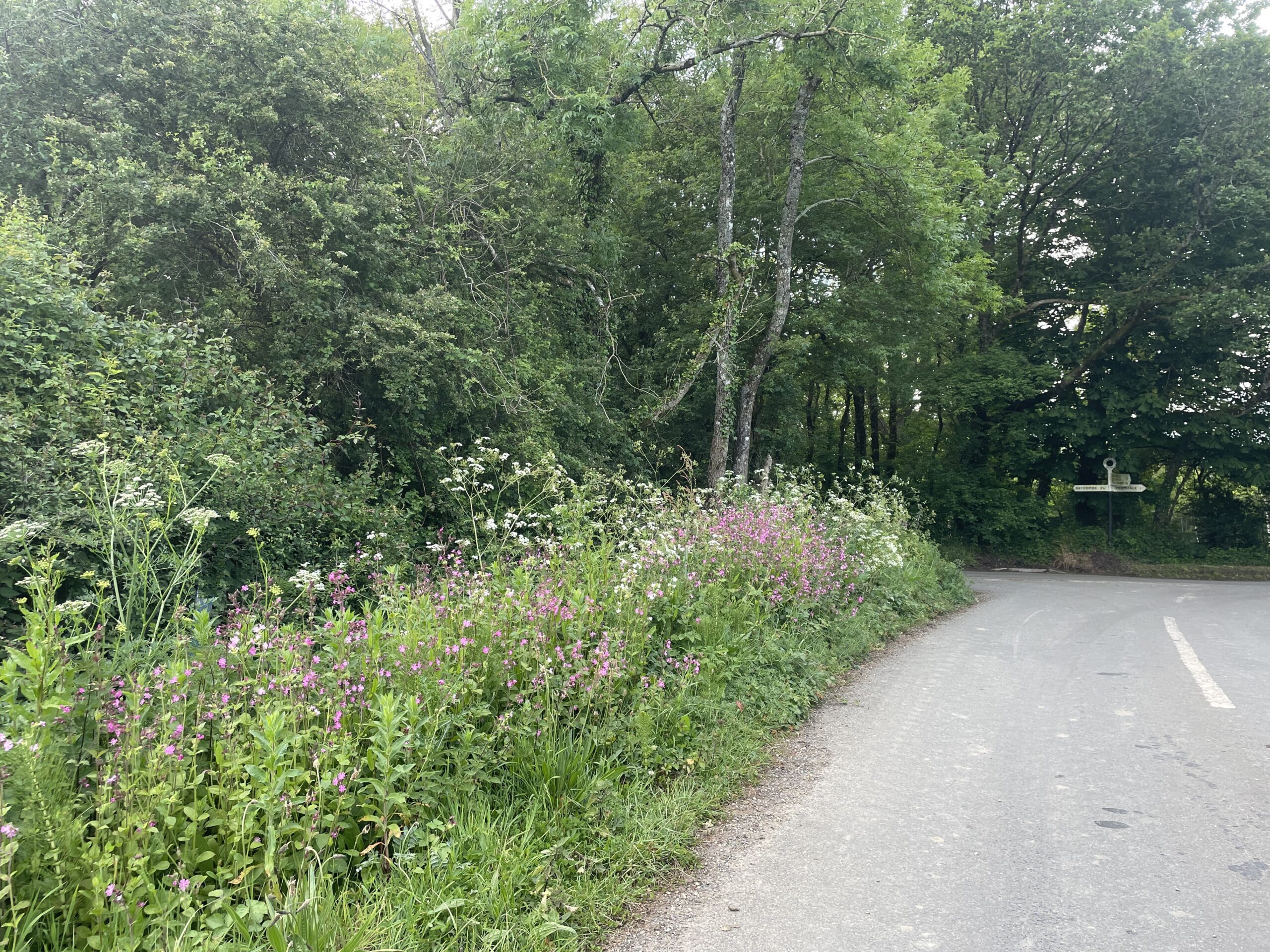
Nature’s pairing: cow parsley with red campion
Plant companionship is not simply about colours, but habits, temperaments, timing and vigour. Different plants behave in different ways. Some suppress or dominate. Some win for a day and die; others fight for supremacy. A plant may live and create particular conditions around it in which other plants may thrive, which in turn provide more conditions for more plants to grow. This is the natural world in which ground growing nothing at all is rare.
This kind of partnership can branch in two ways. On the one hand, some combinations can be acts of strict authorship, whilst on the other hand, they can be collaborations with behaviour. Take clipped yew (Taxus baccata) for instance. Its combination with white roses like R. ‘Iceberg’ is a timeless design choice; once it’s done, that’s it. But what if we choose flame nasturtium (Tropaeolum speciosum) as the yew’s partner? Quite a different story — exacting in its requirements, but once suited, it will do as it likes. Next year it will come up somewhere else and grow in whatever direction it pleases, or it may take a year out.
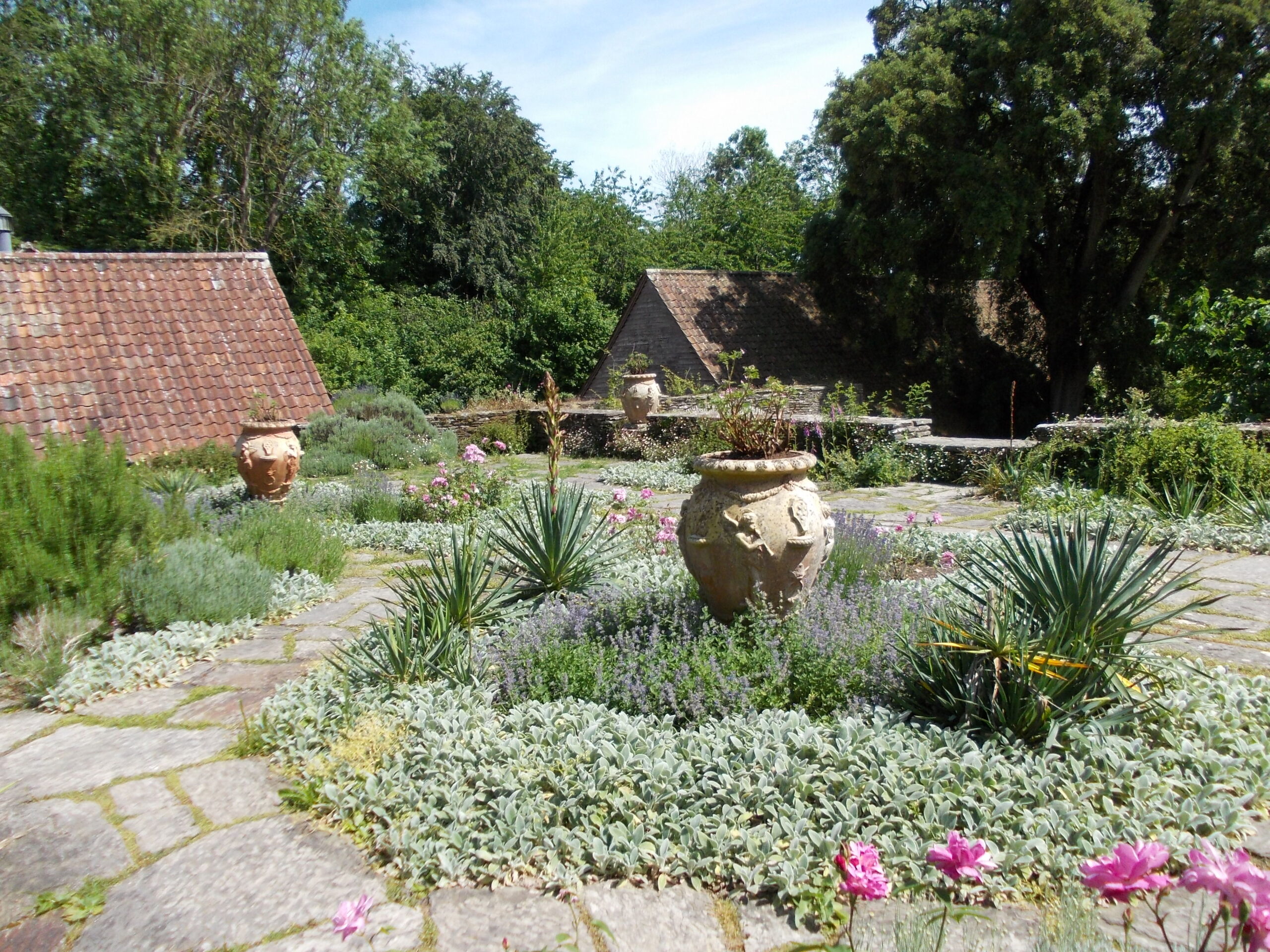
Grey pairings in Gertrude Jekyll’s Dutch garden at Hestercombe
Combinations as acts of strict authorship are no criticism; the great gardeners have devised many that endure and are replicated in countless gardens everywhere, from Gertrude Jekyll (Echinacea purpurea paired with Helenium autumnale and Stachys byzantina), to Christopher Lloyd (Euphorbia robbiae planted under Hydrangea arborescens ‘Annabelle’ with Anemone nemorosa). I know of this example because I unknowingly used the same basic combination, but with a different hydrangea (H. aspera), and Scilla sibirica for early spring. I think mine was better!
These are clever pairings whose members positively support one another. They employ not only the common sense which Jekyll insisted was the most important attribute, but a prodigious knowledge of plants and plantsmanship.
There are some combinations which are perhaps a sideways step. They are some of the most interesting because of being unintended or accidental, or at any rate out of the ordinary. A few simple examples will explain.
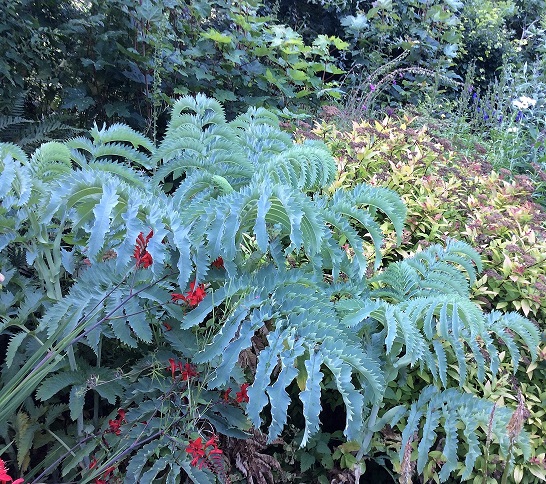
Melianthus major with Crocosmia ‘Lucifer’ — an accidental but forceful pairing, depending less on refinement than on the shock of glaucous foliage against burning red-orange flower.
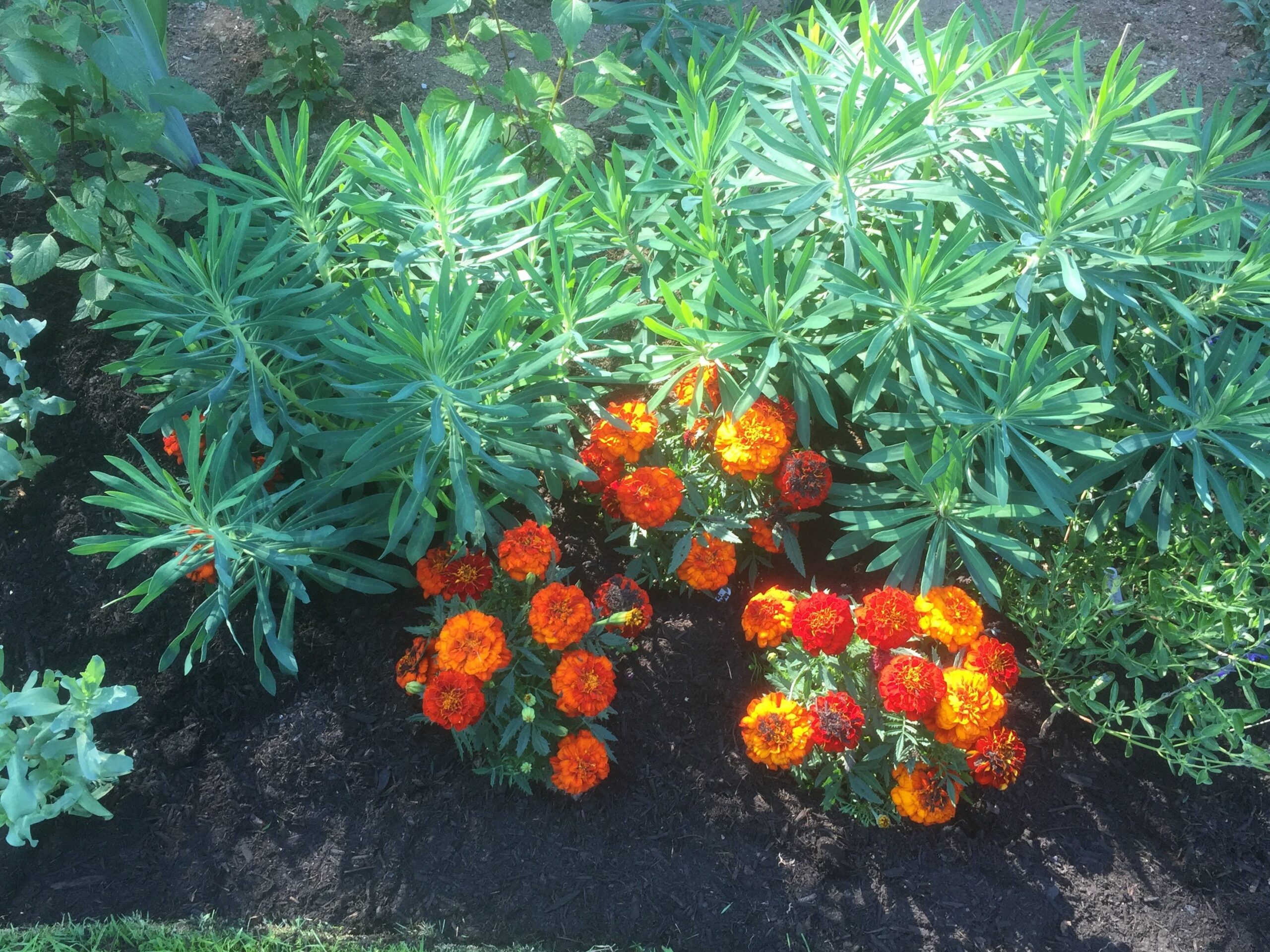
Euphorbia characias subsp. wulfenii with Tagetes patula ‘Cinnabar’ — a more curious association, where the acid green of the euphorbia and the hot, darkened orange of the tagetes make a combination that is almost too assertive, yet difficult to dismiss.
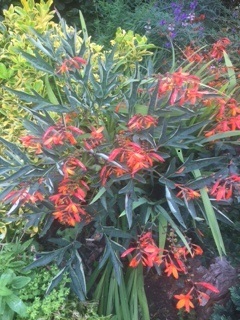
Paeonia delavayi with Crocosmia x crocosmiiflora — less a simultaneous pairing than a succession: the peony provides the earlier weight and framework, while the crocosmia later occupies and animates the same ground.
Some gardeners who are hesitant about using the red-orange part of the spectrum may find combinations like these can help introduce the colour gently.
Collaborations with behaviour can be more powerful; we are not so much in composition territory but emergence. They are typically cottage garden plants like aquilegias, poppies, foxgloves, and verbenas, plants that self-seed, and emerge with planned planting or with one another. A case in point was my encounter with a little crowd of orange Welsh poppies (Papaver cambrica) which came up for the first time ever, around my fairly recently planted Paeonia ‘Sarah Bernhardt’. Orange and pink are not colours that normally sit happily side by side in my opinion, and I had the dilemma about whether to pull up the poppies (before they seeded) and deposit them elsewhere, or leave them to it and move ‘Sarah Bernhardt’. Fortunately nature took care of the issue, for the poppies virtually ended their flush as the paeony started to flower. The poppies will flower more later, after the paeony is over, and brighten up her foliage which does become rather dull.
In discussing colour combinations, it is tempting to think in terms of painting palettes, but there are things that painters can do that gardeners cannot, and vice versa. Plants move, reproduce, outgrow, disappear, reappear, die, or mutate, or all of the above. A painter chooses his paints and uses them to dictate the outcome, on paper or canvas. The gardener doesn’t try to dictate every result and instead learns observation, intervention, restraint, and timing. This is negotiation, persuasion, or guiding tendencies rather than issuing orders.
One advantage we have as gardeners is being able to use plants as markers for plants that die down completely, like Colchicum autumnale. It is always difficult to remember exactly where they are, but Beth Chatto chose to plant Ajuga reptans ‘ Atropurpurea’ exclusively in the same spot, so as to mark them. As ideal companions, the ajuga supports the colchicums physically when they come up in the autumn, with its deep bronze colour that pairs beautifully with the colchicums’ white or pink flowers. One might extend this, by planting A. r. ‘Caitlin’s Giant’ where taller Nerine bowdenii are planted. Other plants that disappear, such as Dicentra spectabilis or Cyclamen hederifolium or coum, can be marked in the same way, with other ground cover plants. Crocus speciosum is another case in point, where its marker can provide much needed structural support, as well as a reminder of where the crocuses are.
Seasonal succession is an obvious opportunity. One idea that sometimes works and sometimes doesn’t, is the concept of planting tulip bulbs amongst dahlias. If dahlias are to be lifted in the autumn (becoming less and less necessary now, I have found), a net of tulip bulbs can fill their gaps, planted in November and lifted when they’re over so that the dahlia can return. This leaves a gap in the winter, perhaps overcome by judicious groundcover. Similar ideas could take care of any herbaceous plants that need lifting to over-winter.
Plant breeders are constantly introducing new cultivars that extend the flowering season at either end, and these can be really useful in augmenting planting schemes in which the colour graduates through one colour to another, provided the new cultivar is not as garish or sensational as they can sometimes be. Even if it is, one might take a leaf out of Christopher Lloyd’s book, and plant something startling as an experiment.
Opportunistic self-seeding is not exactly a technique, rather the deliberate dropping of one’s guard to allow particular plants to grow freely as companions to cultivated partners. This is where the gardener proposes relationships but the garden itself decides whether they endure. It’s popular in vegetable gardening, but highly effective in the flower garden as well, for the likes of foxgloves, alliums, Gladiolus byzantinus, euphorbias, and poppies. Self-seeding in a different form can be entertaining too. Foxglove self-seeding results in their migration through the garden, and self-sown Verbena can expand its small territory.
These companionships often become emotionally more powerful precisely because they were not fully controlled.
Companionship in gardens is constantly changing, in the long term as well as the short. Very often, new or young gardens can be over-designed. And any such garden can include mistakes which only time can reveal, so older gardens often acquire their authority through adaptation. The garden slowly teaches both owner and designer what truly belongs there. Again and again, it is a matter of right plant, right place.
In that partnership of owner/gardener and nature, the point is not that nature ‘wins’ in a catastrophic sense. It’s gentler than that: permanence belongs to natural processes, not human intentions.