
Seasonal Insights
Occasional reflections, sent by email.
SUMMER 2026
Four summer essays linked by atmosphere, companionship, structure, and the quiet relations through which gardens come into being.
Seeing grey
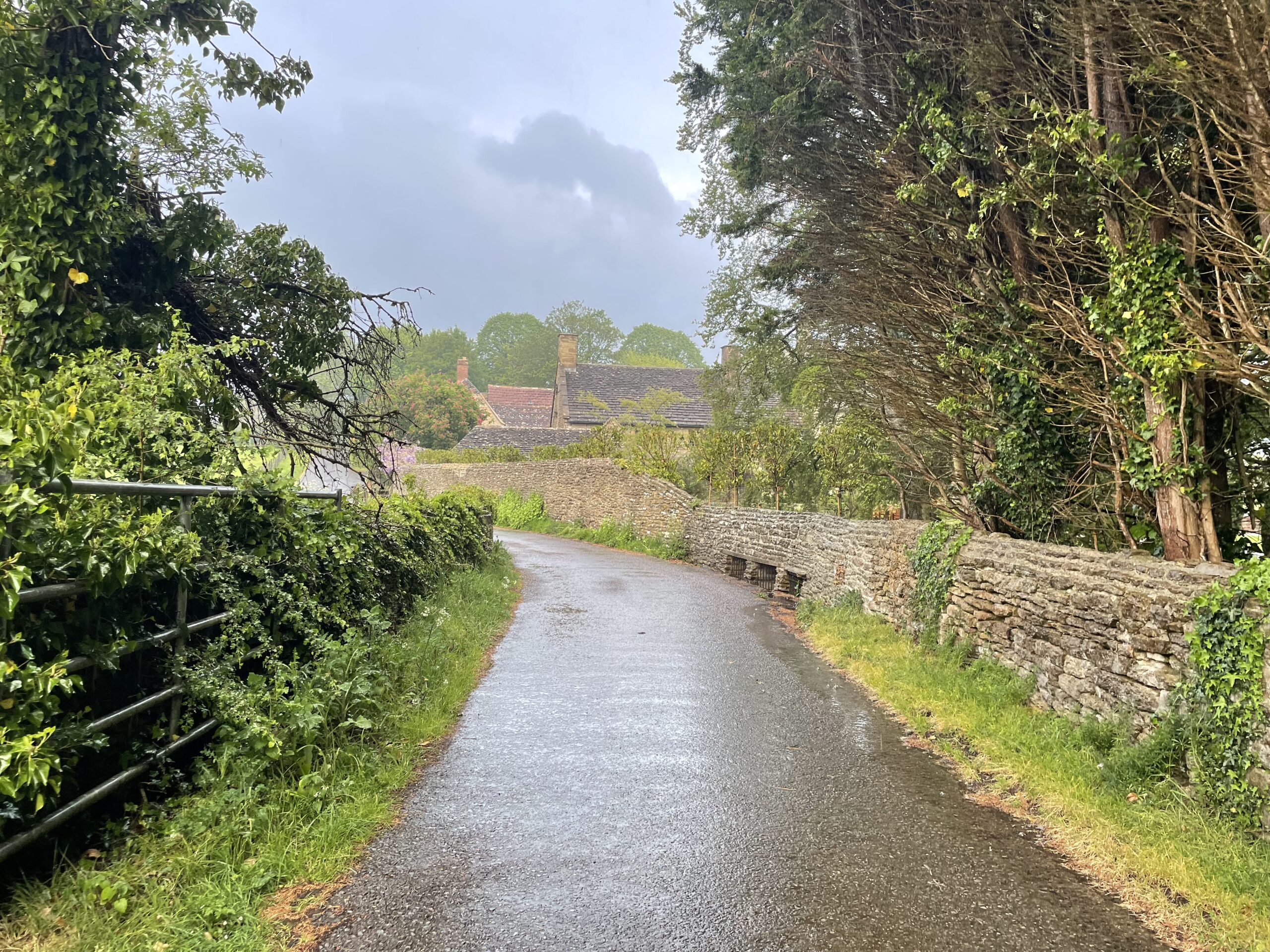
Outdoors, grey is ever-present: one of the most subtle and versatile colours in nature. Yet, ask what people think of the colour grey, and the answer is usually the same: “dull”, “boring”, “old”.
A painter would disagree. A gardener should hesitate too.
Look first at the sky
Even the occasional welcome cloudless sky is never a completely uniform colour. It may aspire to a pure azure at its zenith, but otherwise it’s a blue tempered by grey. For instance, if a water-colourist were to lay a wash for a blue sky, it would probably consist of Cobalt Blue mixed with a very little Light Red to lend it an atmospheric feel – already it’s grey. As the eye follows it to the horizon, the colour changes according to its elevation, the time of day, the impact of sunlight, the temperature even, the distance and so on, becoming progressively greyer.
In between sunshine and clouds there are shadows of course; your painter gets the colour of, for instance, a red brick wall partly in shadow, by adding the complementary colour of the red brick – some sort of green, probably Viridian. Grey again.
More usually there is cloud, all shades of grey, either overcast or in patches, plain or patterned, graduated or even misty, raining, or that peculiarly West Country appearance, mizzling. That’s the context within which we work in the garden. It’s with us the whole time, so much so that it’s easy not to notice it.
And thus there are mornings when a garden seems to have lost its colour. Not in any dramatic sense, but quietly – greens dulled, flowers subdued, everything drawn a little closer to the same tone. And yet, if you stand and look, what emerges is not absence but presence of a different kind. Leaves that seemed ordinary begin to hold the light. Edges soften. Distances lengthen. What at first appears as a loss of colour is, in fact, the arrival of grey – and with it, a different way of seeing.
Grey as a backdrop
In parts of the West Country, especially around Dartmoor, granite is a familiar building stone. Granite is undeniably grey, but far from uniform with red and brown and purple variants. It is durable, which accounts for its widespread use beyond Dartmoor itself, for buildings, walls, chips and gravel, curbstones, rockeries, and so on. Granite can provide high contrast for vibrant foliage and flowers, but it also allows subtler companionships, particularly with drought-tolerant plants such as succulents, lavender, and ornamental grasses. There is even decomposed granite available as a weed-suppressing mulch, very useful in a rock garden. Further east, the stone quarried from Ham Hill is a form of limestone, a more honey-coloured grey of great warmth, especially once it has weathered. Both stones offer special opportunities as backdrops for individual plants and plant combinations. If that were not enough, there is lichen, quietly adding its own character wherever stone allows it to take hold and often doing the same with the bark of trees.
Grey as companion
Perhaps most usefully, grey allows other colours to sit together without conflict. It can soften a meeting that might otherwise jar, or hold a scheme together where variation is needed but harmony must be maintained. In this role, it is rarely noticed directly, yet without it the balance of a planting can easily be lost. All the same, there are grey plants that perform as equals, or even as dominant presences, rather than merely as support. Take, for instance, Eryngium giganteum ‘Miss Willmott’s Ghost’, which Beth Chatto recorded as growing in her dry garden with Allium sphaerocephalon and Stipa tenuissima.
It can be used where a contrast in structure is wanted, without necessarily having to involve other colours. An example might be Astelia ‘Silver Spear’ with Hosta sieboldiana.
Grey appears in different ways; briefly, as with frost; structurally, in stone and bark; or persistently, in foliage shaped by climate.
Grey in Mediterranean conditions behaves differently
In Mediterranean landscapes, this is not a matter of design choice. Grey is not introduced – it emerges.
Under intense and prolonged sun, with limited water and often thin soils, plants take on forms and colours that allow them to endure. Foliage becomes smaller, tougher, often coated or textured in ways that reflect light and reduce moisture loss. The greys and silvers so often admired in planting schemes are, in these conditions, simply the visible expression of survival.
In that light – hard, bright, and directional – grey often appears clearer than one might expect. Leaves that seem subdued under softer skies take on a silvery definition, catching the sun and standing out against deeper shadows.
Set against this, the conditions of the West Country are mostly very different. Light is softer, often diffused; moisture is more constant; soils heavier. The same plants, and the same tones, do not behave in quite the same way. What is integral in one climate can become selective – and sometimes problematic – in another.
Seen in this way, the use of grey in planting here is not a matter of imitation, but of judgement.
‘Right plant, right place’ occurring naturally
There are situations in which grey finds a natural place. In open, well-drained settings, particularly where light is strong and air moves freely, it can take on something of the character it has further south. Gravel gardens, along the Jurassic Coast and the South Devon Coast, have exposed positions, which often allow these tones to hold their clarity, giving a planting both lightness and cohesion. Not only this, but plants like Griselinia and Crambe have thick waxy foliage, Tamarix has scaly leaves, and Echinops has silvery leaves, all of which protects them against greater weather exposure. This is ‘Right plant, right place’ occurring naturally.
Avoiding clashing colours
Grey can be valuable in creating a buffer to separate two contrasting, vibrant plant colours and prevent them clashing, or to calm down bold, rich colour palettes. Between strong colours, or alongside hard materials such as stone and gravel, it allows a scheme to settle without becoming static. Used in this way, it supports rather than competes, and helps a planting to read as a whole rather than as a series of parts. Artemisia ‘Powis Castle’, Santolina chamaecyparis, and Stachys byzantina are key plants here. With their fine-textured leaves, they also provide a useful contrast to the bolder greens that often accompany strong-coloured flowers.
Equally, there are conditions in which grey struggles to find its place. In heavier soils, or where moisture lingers, the same plants can lose their definition. Foliage softens, tones dull, and what might have appeared clear and purposeful becomes indistinct. Without the right light and drainage, grey can flatten rather than illuminate.
Grey as a plant colour in its own right
Grey as a flower colour is rare. Often a flower appears grey as a result of a combination of colours, like Iris ‘Katherine Hodgson’. There are a few roses that pretend to be grey, but they aren’t really very convincing. Allium ‘Silver Spring’ and Agapanthus ‘Silver Baby’ read as a pale grey rather than a true silver. Salvia apiana, white sage, succeeds with its flowers, helped by its grey foliage. Iris is a genus in which genuine grey flowers occur; as they do in hostas, quite apart from their many blue-grey possibilities.
Foliage is a different story. Artemisia ‘Powis Castle’ leads the field as a splendid plant in its own right (as well as being a foil for different strong colours such as red sedums); Melianthus major is a favourite architectural perennial; Caryopteris is good; there are many salvias.
Grey: a colour that asks little but gives much
There is a risk of overuse. Because grey is often seen as neutral, it can be repeated too readily, until a planting loses contrast and vitality. What was intended as subtlety becomes monotony. Like any restraint, it depends on contrast to have meaning.
Used with care, grey brings cohesion, depth, and responsiveness to light. Used without regard to context, it can do the opposite. The difference lies not in the plants themselves, but in how and where they are placed.
Grey is rarely the first colour noticed in a garden, and perhaps for that reason it is often overlooked. Yet once understood, it changes how a planting is read – not by asserting itself, but by shaping everything around it. It is a colour that asks little, but gives much in return, provided the conditions are right and the eye is willing to see it.
Plant companions
Control in the garden is an illusion. In this environment, the owner/gardener may plan, specify, or arrange, or propose relationships between plants, but the garden itself decides whether they endure. Even the most disciplined garden is still a negotiation with biology and weather, not a victory over them. Nature holds the cards. In other words, the successful plant community we call a garden is a partnership of three: owner, gardener/designer, and nature. The first two can be a single person, but the third doesn’t care, and is going to win anyway.
Painting and gardening are deeply intertwined. Whilst a painter mixes colours and applies them to paper or paint to capture light and texture, a gardener uses plants, earth, and seasonal change to paint with nature. The two disciplines are closely related: the garden just has earth instead of canvas, and living plants instead of pigments. Plus three other elements: the fact that the garden has three dimensions rather than two, the fact that the medium applied is alive and will grow, and the overarching element of time. The painting/gardening milestone is surely Claude Monet’s garden at Giverny, with its water lilies and Japanese bridge; Turner’s influence on Gertrude Jekyll as an artist arose a little later, and painting and gardening were firmly linked from then onwards.
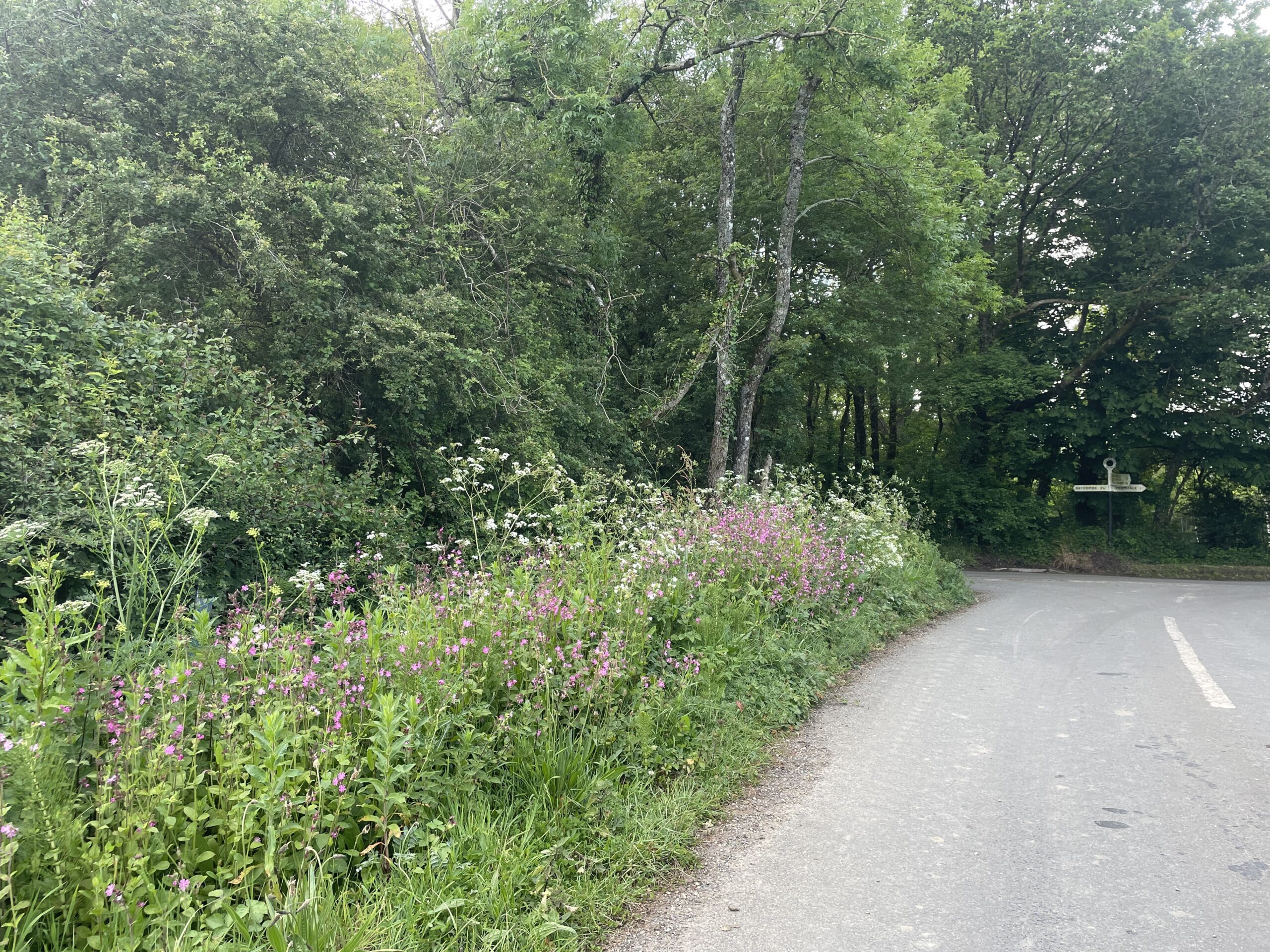
Nature’s pairing: cow parsley with red campion
Plant companionship is not simply about colours, but habits, temperaments, timing and vigour. Different plants behave in different ways. Some suppress or dominate. Some win for a day and die; others fight for supremacy. A plant may live and create particular conditions around it in which other plants may thrive, which in turn provide more conditions for more plants to grow. This is the natural world in which ground growing nothing at all is rare.
This kind of partnership can branch in two ways. On the one hand, some combinations can be acts of strict authorship, whilst on the other hand, they can be collaborations with behaviour. Take clipped yew (Taxus baccata) for instance. Its combination with white roses like R. ‘Iceberg’ is a timeless design choice; once it’s done, that’s it. But what if we choose flame nasturtium (Tropaeolum speciosum) as the yew’s partner? Quite a different story — exacting in its requirements, but once suited, it will do as it likes. Next year it will come up somewhere else and grow in whatever direction it pleases, or it may take a year out.
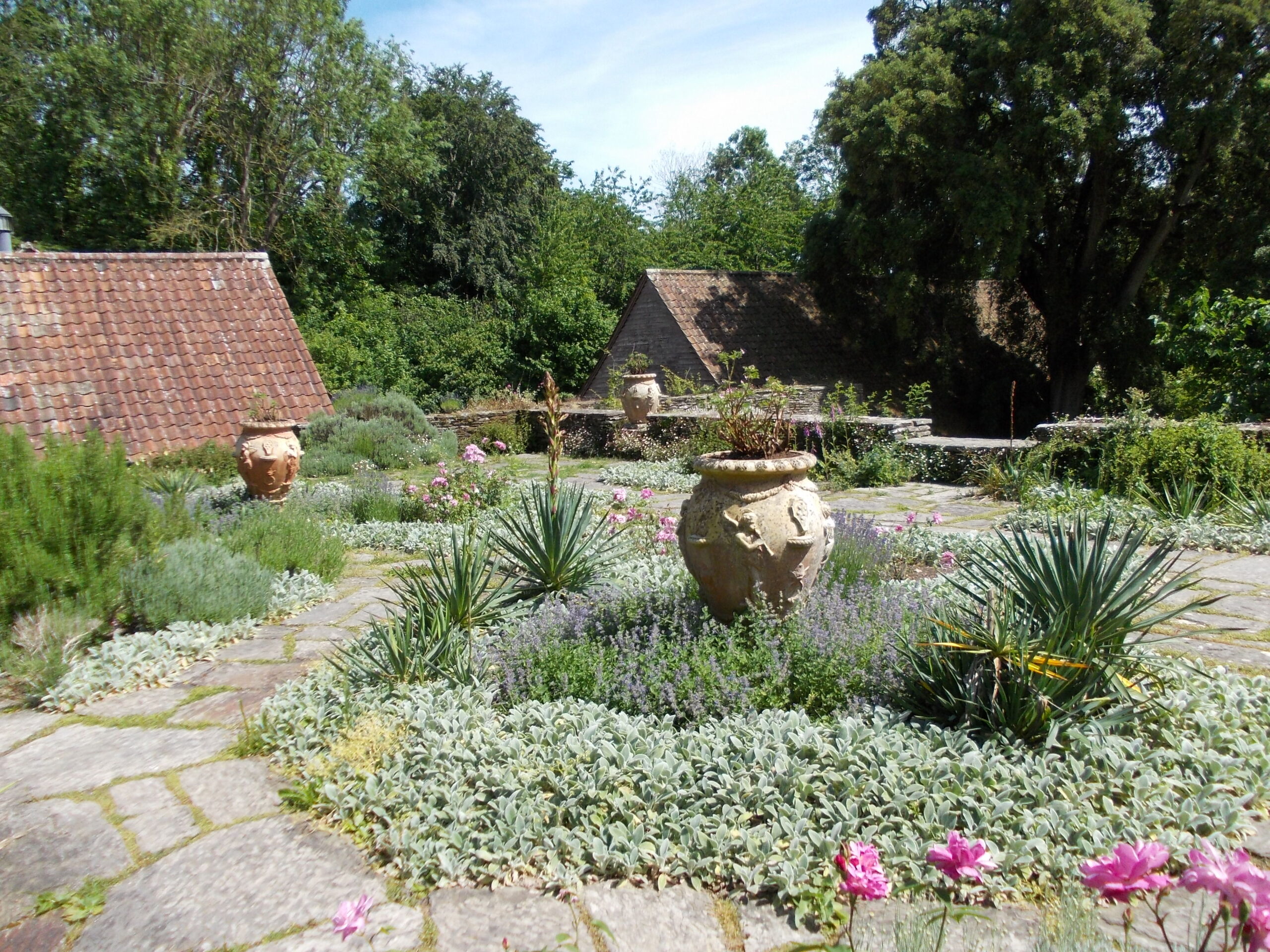
Grey pairings in Gertrude Jekyll’s Dutch garden at Hestercombe
Combinations as acts of strict authorship are no criticism; the great gardeners have devised many that endure and are replicated in countless gardens everywhere, from Gertrude Jekyll (Echinacea purpurea paired with Helenium autumnale and Stachys byzantina), to Christopher Lloyd (Euphorbia robbiae planted under Hydrangea arborescens ‘Annabelle’ with Anemone nemorosa). I know of this example because I unknowingly used the same basic combination, but with a different hydrangea (H. aspera), and Scilla sibirica for early spring. I think mine was better!
These are clever pairings whose members positively support one another. They employ not only the common sense which Jekyll insisted was the most important attribute, but a prodigious knowledge of plants and plantsmanship.
There are some combinations which are perhaps a sideways step. They are some of the most interesting because of being unintended or accidental, or at any rate out of the ordinary. A few simple examples will explain.
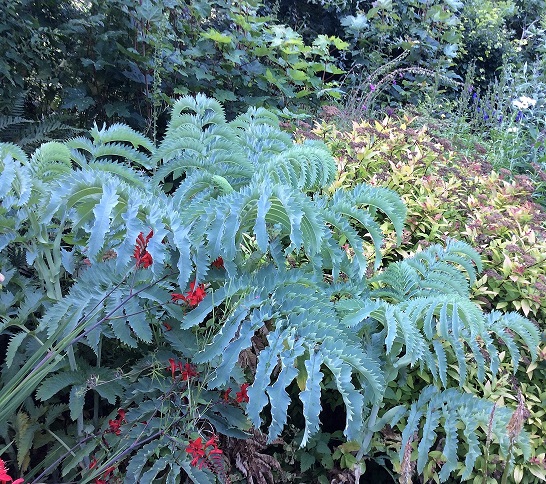
Melianthus major with Crocosmia ‘Lucifer’ — an accidental but forceful pairing, depending less on refinement than on the shock of glaucous foliage against burning red-orange flower.
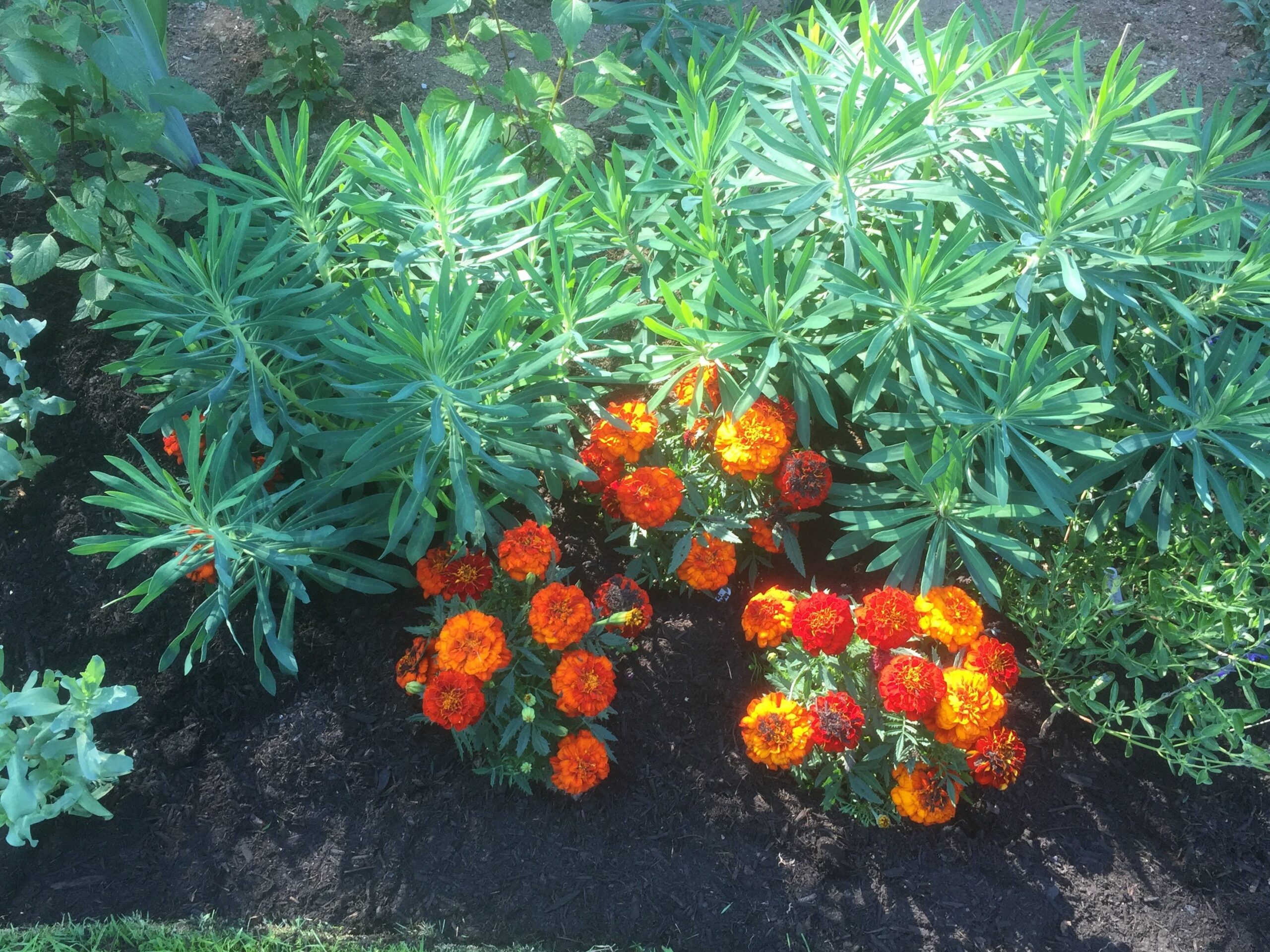
Euphorbia characias subsp. wulfenii with Tagetes patula ‘Cinnabar’ — a more curious association, where the acid green of the euphorbia and the hot, darkened orange of the tagetes make a combination that is almost too assertive, yet difficult to dismiss.
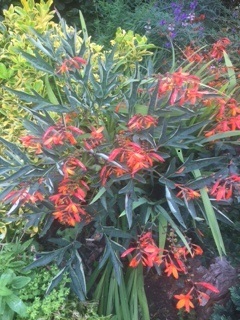
Paeonia delavayi with Crocosmia x crocosmiiflora — less a simultaneous pairing than a succession: the peony provides the earlier weight and framework, while the crocosmia later occupies and animates the same ground.
Some gardeners who are hesitant about using the red-orange part of the spectrum may find combinations like these can help introduce the colour gently.
Collaborations with behaviour can be more powerful; we are not so much in the territory of composition as of emergence. They are typically cottage garden plants like aquilegias, poppies, foxgloves, and verbenas, plants that self-seed, and emerge with planned planting or with one another. A case in point was my encounter with a little crowd of orange Welsh poppies (Papaver cambrica) which came up for the first time ever, around my fairly recently planted Paeonia ‘Sarah Bernhardt’. Orange and pink are not colours that normally sit happily side by side in my opinion, and I had the dilemma about whether to pull up the poppies (before they seeded) and deposit them elsewhere, or leave them to it and move ‘Sarah Bernhardt’. Fortunately nature took care of the issue, for the poppies virtually ended their flush as the paeony started to flower. The poppies will flower more later, after the paeony is over, and brighten up her foliage which does become rather dull.
In discussing colour combinations, it is tempting to think in terms of painting palettes, but there are things that painters can do that gardeners cannot, and vice versa. Plants move, reproduce, outgrow, disappear, reappear, die, or mutate, or all of the above. A painter chooses his paints and uses them to dictate the outcome, on paper or canvas. The gardener doesn’t try to dictate every result and instead learns observation, intervention, restraint, and timing. This is negotiation, persuasion, or guiding tendencies rather than issuing orders.
One advantage we have as gardeners is being able to use plants as markers for plants that die down completely, like Colchicum autumnale. It is always difficult to remember exactly where they are, but Beth Chatto chose to plant Ajuga reptans ‘Atropurpurea’ exclusively in the same spot, so as to mark them. As ideal companions, the ajuga supports the colchicums physically when they come up in the autumn, with its deep bronze colour that pairs beautifully with the colchicums’ white or pink flowers. One might extend this, by planting A. r. ‘Caitlin’s Giant’ where taller Nerine bowdenii are planted. Other plants that disappear, such as Dicentra spectabilis or Cyclamen hederifolium or coum, can be marked in the same way, with other ground cover plants. Crocus speciosum is another case in point, where its marker can provide much needed structural support, as well as a reminder of where the crocuses are.
Seasonal succession is an obvious opportunity. One idea that sometimes works and sometimes doesn’t, is the concept of planting tulip bulbs amongst dahlias. If dahlias are to be lifted in the autumn (becoming less and less necessary now, I have found), a net of tulip bulbs can fill their gaps, planted in November and lifted when they’re over so that the dahlia can return. This leaves a gap in the winter, perhaps overcome by judicious groundcover. Similar ideas could take care of any herbaceous plants that need lifting to over-winter.
Plant breeders are constantly introducing new cultivars that extend the flowering season at either end, and these can be really useful in augmenting planting schemes in which the colour graduates through one colour to another, provided the new cultivar is not as garish or sensational as they can sometimes be. Even if it is, one might take a leaf out of Christopher Lloyd’s book, and plant something startling as an experiment.
Opportunistic self-seeding is not exactly a technique, rather the deliberate dropping of one’s guard to allow particular plants to grow freely as companions to cultivated partners. This is where the gardener proposes relationships but the garden itself decides whether they endure. It’s popular in vegetable gardening, but highly effective in the flower garden as well, for the likes of foxgloves, alliums, Gladiolus byzantinus, euphorbias, and poppies. Self-seeding in a different form can be entertaining too. Foxglove self-seeding results in their migration through the garden, and self-sown Verbena can expand its small territory.
These companionships often become emotionally more powerful precisely because they were not fully controlled.
Companionship in gardens is constantly changing, in the long term as well as the short. Very often, new or young gardens can be over-designed. And any such garden can include mistakes which only time can reveal, so older gardens often acquire their authority through adaptation. The garden slowly teaches both owner and designer what truly belongs there. Again and again, it is a matter of right plant, right place.
In that partnership of owner/gardener and nature, the point is not that nature ‘wins’ in a catastrophic sense. It’s gentler than that: permanence belongs to natural processes, not human intentions.
Where the garden climbs
Scale matches scale
There are moments in gardens when a plant stops being merely part of the scene and becomes the reason for it. Arriving at Montacute House in late summer, what strikes me first is the honey-coloured Hamstone wall beside the approach, largely enveloped by Campsis radicans. The effect is overwhelming. It brought to mind lines of Tennyson learnt long ago — ‘The splendour falls…’ — and Elgar’s marking, nobilmente. I have seen C. radicans starting to grow up a modern house wall, where it looked absurd. The question is why this climber feels inevitable here, when elsewhere it can seem preposterous. At Montacute, the climber matches not just the surface, but the weight of what it climbs.
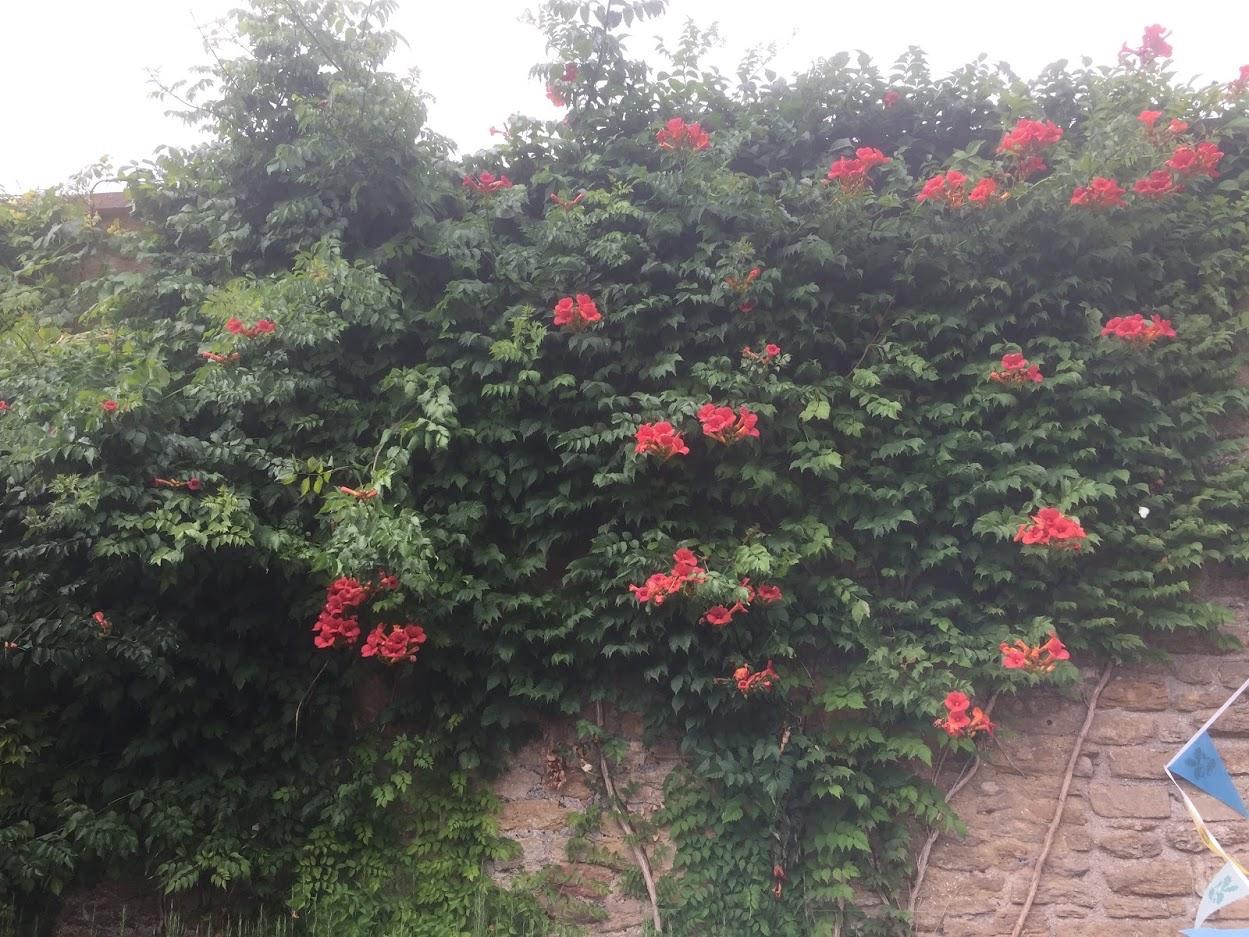
The image shows the sweep of growth across the breadth of masonry, and the idea that the plant occupies the architecture rather than merely decorating it. The relationship between foliage mass and stone is what the success of the climber depends on.
Material and plant in dialogue
There is no shortage of advice on climbers: lists of reliable performers, flowering times, suitable aspects, and combinations of colour. Useful though such guidance can be, it rarely touches upon the more interesting question of what climbers actually do within a garden. For climbers are not merely plants that happen to grow upwards. Their role within gardens is often far greater than this practical guidance alone might suggest. Climbers are fundamentally about connection: walls to planting, architecture to landscape, and the horizontal plane of the garden to the vertical world above it.
Climbers and the vertical plane
Most planting occupies the horizontal plane. Climbers allow planting to rise. They are invaluable in even the smallest of gardens, by increasing the total planting surface, and diminishing the feeling of confinement within a tight perimeter. All gardens must finish somewhere; at their boundary walls or fences, the climber can rise to blur any abrupt termination, or connect to adjoining plants or structures, or suspend or drape around a wall or fence, or even cover or even disguise an eyesore.
Pergolas and arches are often built expressly for climbers, though they are most convincing when they serve a larger architectural purpose within the garden rather than existing as isolated ornaments.
Climbers as emotional amplifiers
Climbers behave differently on architecture than on garden structures like pergolas and arches. A pergola is intended to carry planting; a house façade is not. So once a climber moves onto a building, questions immediately arise: does it soften the architecture, or compete with it, or obscure it? And, does it reveal its proportions, or romanticise it, or overwhelm it? Such a climber is not simply a decorative addition – it is an agent that alters how the architecture itself is perceived.
Clematis: the companionable climber
What distinguishes clematis from many climbers is its willingness to enter into partnership — with shrubs, roses, even trees. Rather than overwhelming its hosts, it threads through them, borrowing support while contributing delicacy, colour, and seasonality in return. At its best, clematis does not so much occupy a structure as enter a relationship.
Climbing roses
Climbing roses occupy a middle ground between climber and shrub: less architectural than wisteria, less flamboyant than Campsis, but capable of lending softness and romance to walls, pergolas, and trees alike. They do not usually transform masonry with the same force as a trumpet vine or wisteria; their gift is more intimate, softening edges and bringing flower to a vertical plane without necessarily overwhelming it.
Context and suitability
‘Right plant, right place’ has usually — (and rightly) — been applied to soil, drainage, aspect, and climatic conditions. Yet suitability extends beyond cultivation alone. There is architectural context, emotional context, historical context, and questions of scale and temperament.
That contrast between Campsis at Montecute and the potted Campsis attempting to rise towards Wisteria sinensis, illustrates the point.
Climbers and temperament
Most plants are probably chosen because of how they look, whether alone or in association with others, climbers included. But particularly with climbers, there is an emotional tone and the atmosphere over and above their visual appearance. For example:
- Ivy: permanence and endurance
- Wisteria: anticipation and elegance
- Campsis: heat and exuberance
- Clematis: intimacy and companionship
Climbers as time
A wall or a fence disappears under the growth of climbers, and reappears. It softens, then burns with colour, and eventually becomes skeletal again. A wall’s climbers introduce duration, succession, maturity, and implied age.
Gertrude Jekyll understood belonging and context
Gertrude Jekyll understood a great deal about the relationship between structures and the plants that can grow upon them. She despaired of the number of pleasure-grounds that are planted apparently without thought or inspiration, and found climbing plants presented by little wayside cottage gardens, that teach a lesson in better planting, of great simplicity.
She understood, as we all should, that climbers are not ornaments attached to gardens. They are among the means by which gardens acquire depth, age, atmosphere, and emotional scale.
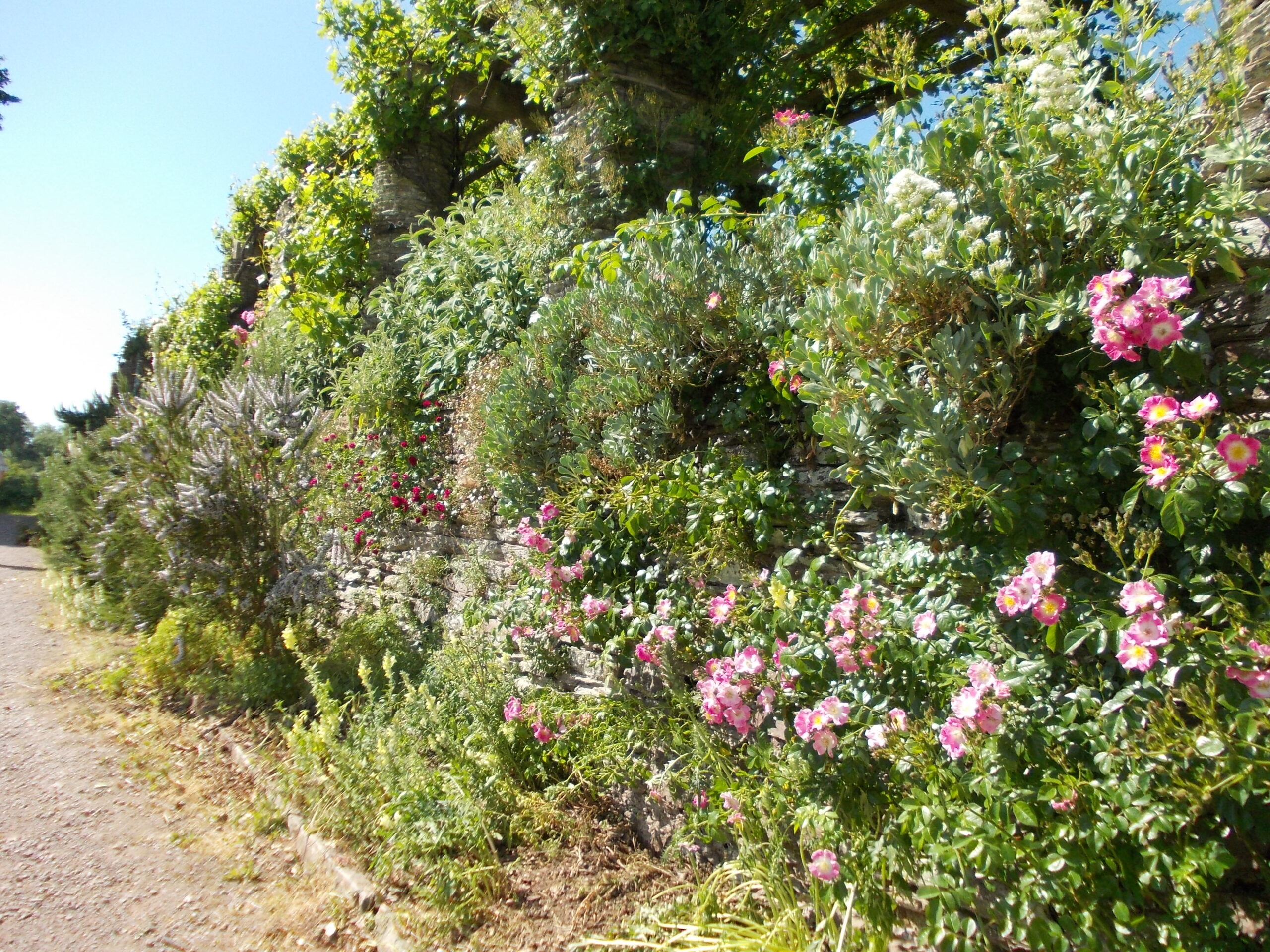
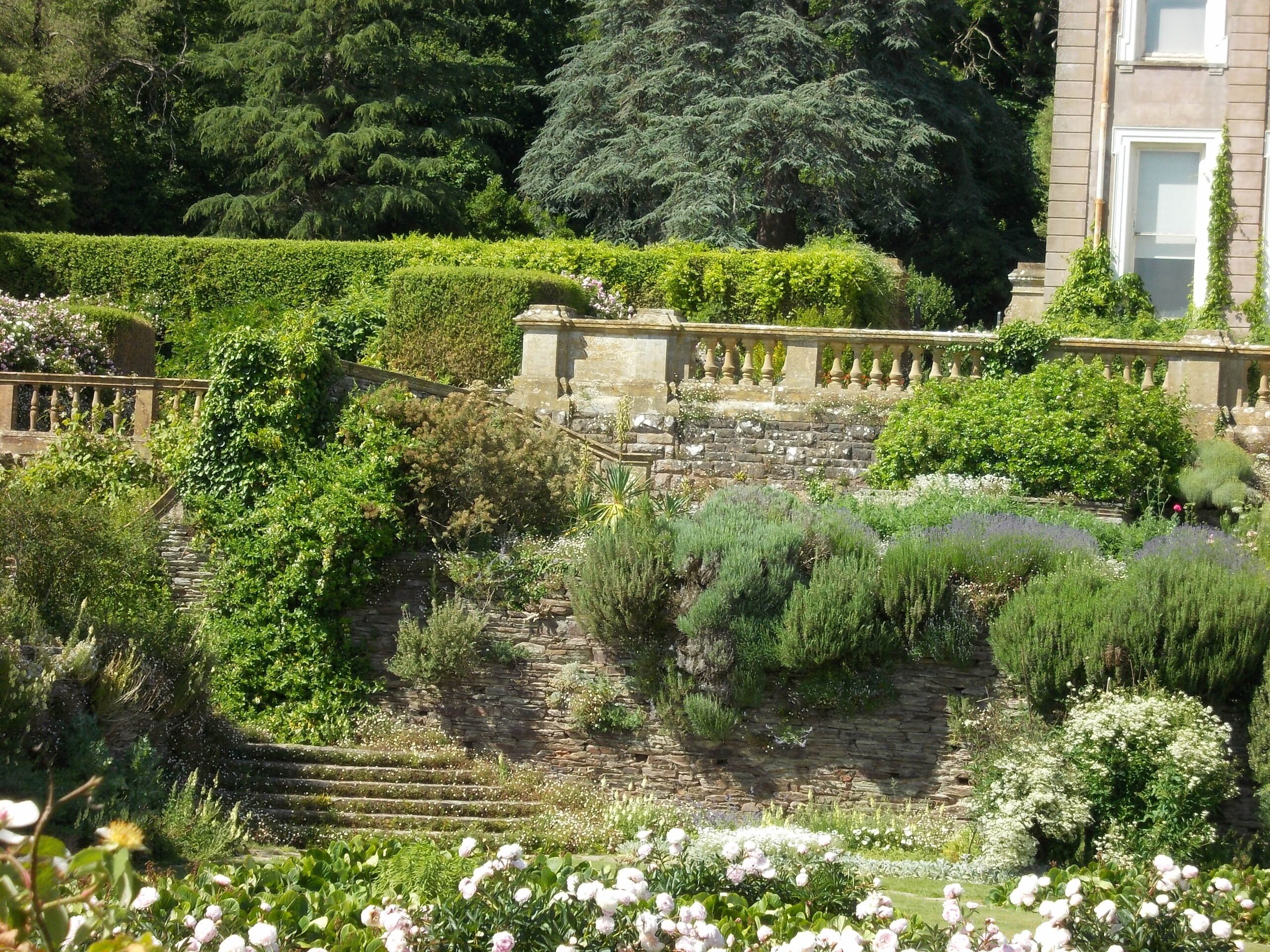
The wall of a terrace with roses and other climbers throughout its long length, at Hestercombe
A mature climber does more than decorate a structure. It settles and alters it, and eventually becomes inseparable from it. Walls acquire softness and gardens gain not merely height but atmosphere, memory, and a sense of duration. Climbers are among the means by which planting leaves the ground and becomes part of the architecture of a place.
Gertrude Jekyll
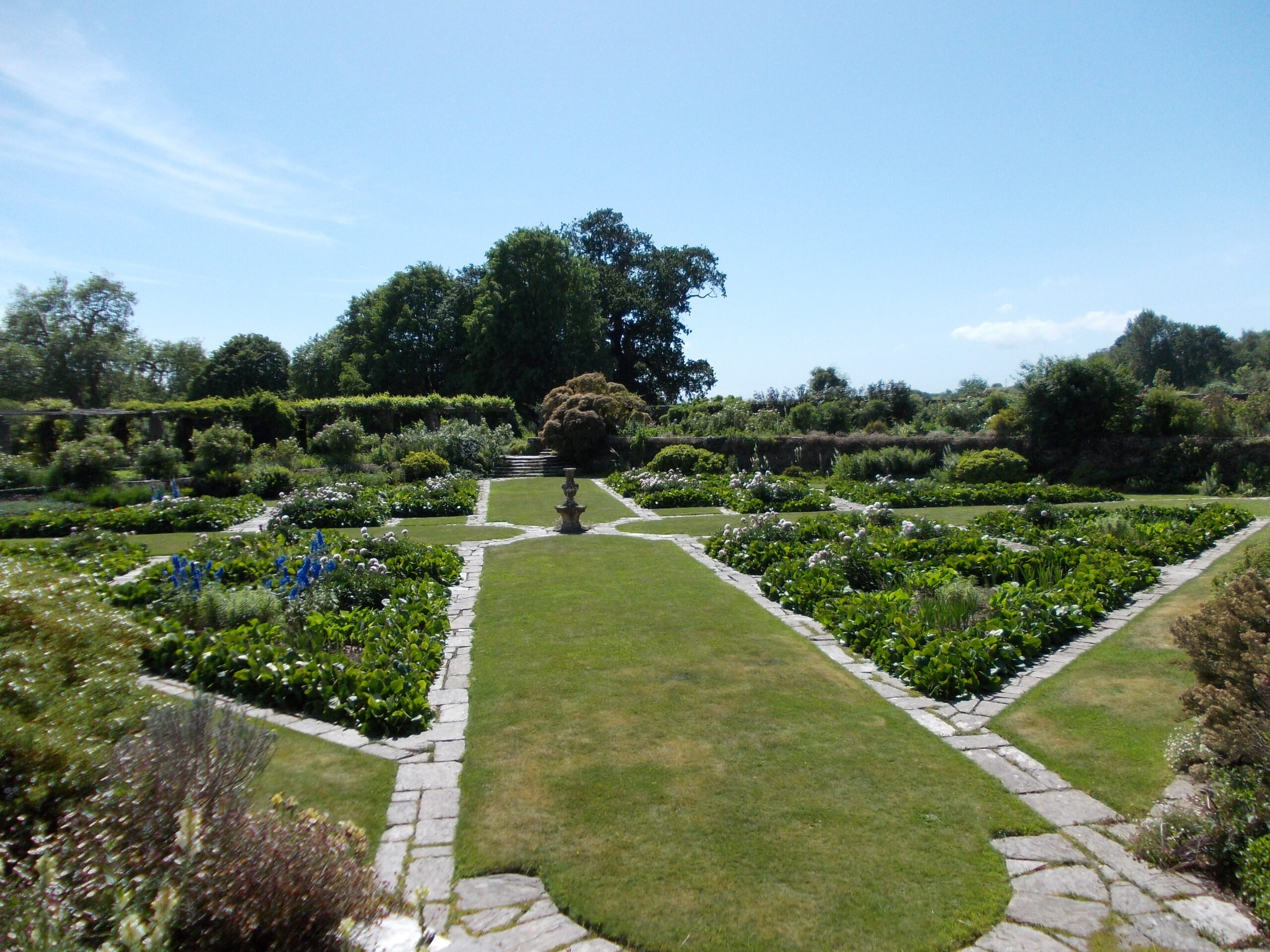
Gertrude Jekyll remains one of the most admired and yet most misunderstood figures in British gardening.
There is a persistent myth that Jekyll turned to gardening because her eyesight had become too poor for painting. It is misleading. Her eyesight certainly caused difficulty, but she continued to observe in extraordinary detail and applied what she saw with unfailing accuracy.
She was not a sentimental cottage gardener pushed accidentally into horticulture by failing sight, but an artist and craftswoman whose understanding of colour, atmosphere, structure, and flow naturally found expression in gardens. She did not so much switch to gardening as allow her painting and craftsmanship to lead her there.
Much of Gertrude Jekyll’s understanding of colour was shaped by studying and copying Turner in the National Gallery. Turner’s works are always atmospheric and luminous, and they express tonal transitions and dissolving edges; above all, movement and emotional colour. That makes Jekyll’s planting philosophy intelligible at a deeper level. She was an artist beforeshe was a gardener. I think of her as a true artist-gardener.
There is another misconception, about Gertrude Jekyll’s partnership with Edwin Lutyens. The perception was, and to an extent still is, that Lutyens did the rigid architecture whilst Jekyll filled it in with soft, overflowing plants. But that caricature of Lutyens representing masculine structure and Jekyll as feminine softness is an oversimplification. It’s clear from Jekyll’s gardens and from her writings, that she was very interested in the interplay between structures and planting and regarded them as inseparable.
Two West Country gardens may shed light on Jekyll’s approach. Hestercombe House near Taunton is widely thought her masterpiece collaboration with Lutyens. On the other hand, Lutyens brought in Jekyll 15 years later, to assist with the planning of Castle Drogo, but in the event, Jekyll’s contribution was limited tothe planting fot the approach to the castle. Perhaps the scale or style of the project was off-putting; the castle we see today is big, but Lutyens’ original design was for an edifice three times the size. Lutyens himself regretted that his client insisted on a castle, rather than the major house with big rooms that he would have been more comfortable designing. Perhaps Jekyll felt the same.
In 1986, David Austin introduced a new rose and named it ‘Gertrude Jekyll’, to honour her influence on English gardening. It has become one of the most popular of roses for good reason. But this well-intentioned tribute has had an unfortunate consequence; Jekyll has been remembered superficially as a creator of “cottage garden colour”. She was capable of cottage-garden colour, of course, but she was much more than that: a plantswoman who understood gardening as an art, and plants as belonging to architecture, landscape, atmosphere, and place. Somehow that lovely rose has reinforced a notion of Gertrude Jekyll as a gentle Edwardian lady, instead of the feisty tree-climbing, cricket-loving craftswoman she was.
There is a final misunderstanding, and it is quite a subtle one. The Arts and Crafts movement around the start of the 20th century encompassed all aspects of craftsmanship, including the integration of architecture and horticulture. It’s not surprising that Gertrude Jekyll and Edwin Lutyens between them perfected its garden ideals. Their work defined the classic Arts and Crafts garden, which included combined structured units such as ‘garden rooms’. This concept was exemplified by Vita Sackville-West and Harold Nicolson, magnificently at Sissinghurst, which became a world-famous garden. However, it perhaps encouraged a misleading view of Jekyll’s work as similarly sectional. Sissinghurst’s distinct independent garden compartments are theatrical, one enclosed space leading to another, with surprise and revelation. Jekyll herself seems more interested in progression, harmony, and visual flow. Her ‘rooms’, where they exist, are not arbitrary, but are dictated by the natural transitions of the space she has to deal with. At Hestercombe we experience these transitions as unfolding views and flowing relationships between spaces — not as abrupt isolated garden chambers existing independently.
Time and again in her writing, Jekyll describes gardens not as static arrangements but as experiences unfolding gradually through space and season. Just as a herbaceous border changes through the seasons, so the garden itself becomes a progression rather than a collection of compartments. The later popularity of strongly defined garden rooms, magnificent though they can be, perhaps obscures this more fluid aspect of Jekyll’s imagination. Her gardens move. One passes in and through them much as the eye moves through a painting, by transition, harmony, and changing emphasis rather than abrupt separation. Her borders can feel surprisingly Turneresque: tonal rather than schematic, atmospheric rather than sharply bounded.
Sir Edwin Lutyens had this inscribed on Gertrude Jekyll’s tombstone: Artist – Gardener – Craftswoman.