
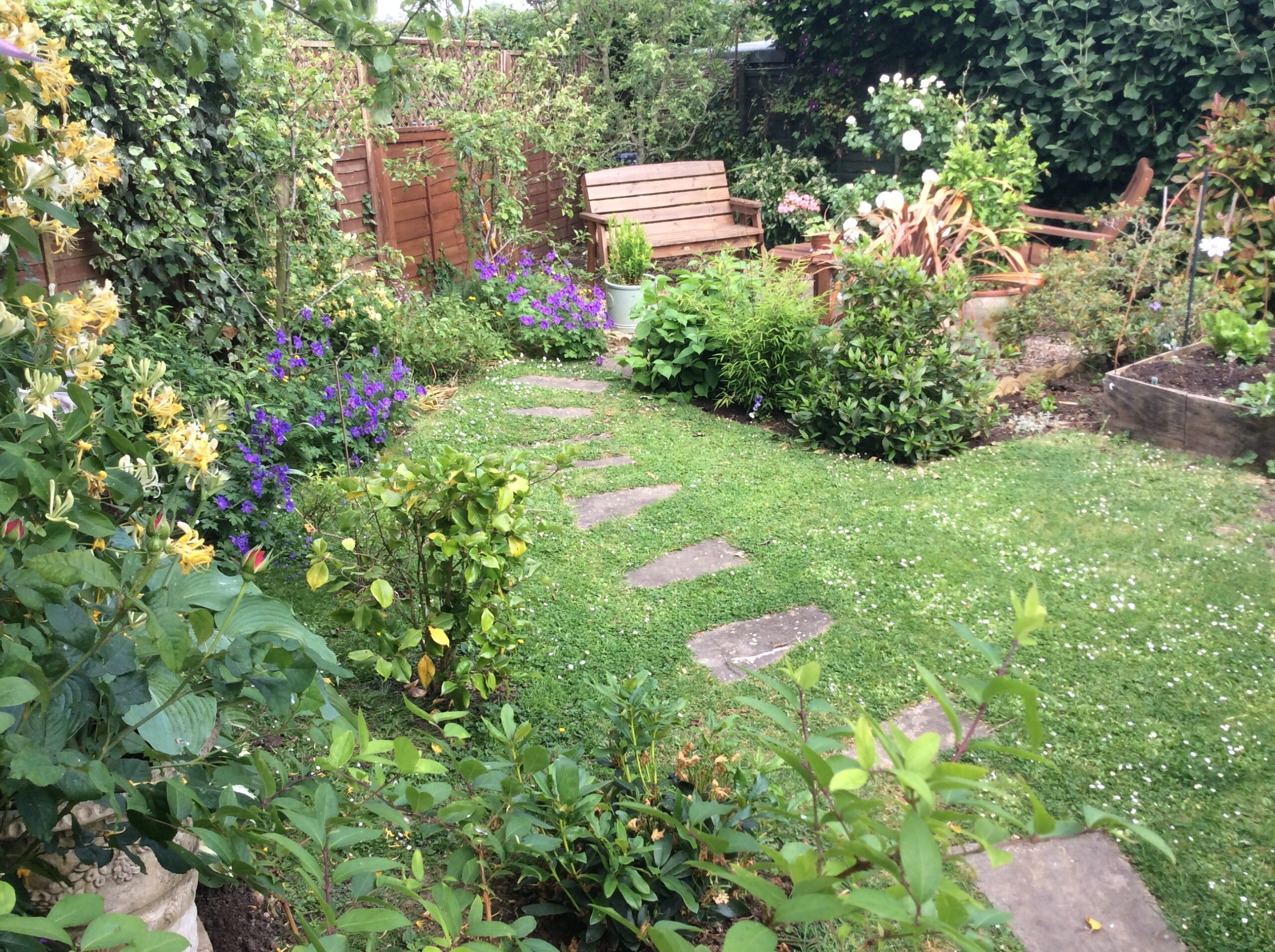
A border held together by dense groundcover planting — less work, and no less presence.
There comes a point — sometimes suddenly, more often gradually — when a garden begins to ask more than it gives.
Of course, no two gardens—or gardeners—are the same.
Some changes come suddenly, through illness or accident. Others arrive gradually, almost unnoticed. What is manageable for one person may be too much for another, even in similar circumstances.
It may follow illness, or arrive almost unnoticed over time. Strength lessens, time becomes tighter, other demands intervene. What was once a pleasure begins to feel like something that must be kept up with. Tasks are put off. Corners are left. The garden, so carefully made over years, starts to slip out of balance with its owner.
I’ve found myself thinking about this more often in recent years. Not in theory, but in practice. Gardens do not stand still, and neither do we.
When the balance begins to shift
It isn’t simply a matter of size. A small garden can make heavy demands, just as a large one can be surprisingly manageable.
The real issue is the relationship between the garden and the person looking after it. When that relationship changes — through time, energy, or circumstance — the garden does not automatically adjust. It carries on as before, asking for the same work, the same attention, the same commitment.
That is when it begins, quietly, to feel like too much.
Why it happens
Most gardens are made for a particular moment in life.
They reflect the time, energy, and ambition of their making. Plants are chosen with optimism. Spaces are shaped for use as it once was. Maintenance is assumed rather than examined.
Years later, those assumptions may no longer hold. Plants have grown beyond their allotted space. Layouts that once worked now make access awkward. Time is shorter. Energy is not what it was. The garden, in a sense, belongs to an earlier version of its owner.
Cost plays its part too. While in work, it may be possible to bring in help. Later on, that may not be so easy, just at the point when it might be most needed.
And help, where it is available, is rarely quite what one imagines. Skilled gardeners are scarce. More often, the available help is practical rather than horticultural — digging, mowing, clearing. hedge-trimming. Useful, certainly, but not a complete answer.
The difficulty with change
This is where it becomes delicate.
To alter a garden that has been built up over many years is not straightforward. Every plant may carry a memory. Every part may feel earned.
What may seem an obvious simplification from a design point of view can feel, to the owner, like loss. And sometimes it is.
The question is not simply what can be removed, but what can be changed without losing the spirit of the place.
What often happens instead
More often, things are managed rather than addressed.
Parts of the garden are avoided. Work is done in bursts. Some areas are kept going; others quietly decline. The intention is always to catch up later.
But the balance has already shifted, and catching up becomes harder each season.
is also the question of realism. It is very easy to be sidetracked — to start one task and drift into another, and at the end of the day to have achieved less than intended. In a garden that is already becoming too much, that tendency makes things harder still. I recognise this all too well.
A more realistic approach
There is another way of looking at it.
Not as giving up, but as bringing the garden back into proportion — finding a different balance between what the garden asks, and what can realistically be given.
That may mean reducing rather than adding. Simplifying rather than refining. Accepting that not everything needs to be maintained at the same level.
In practical terms, this might involve:
- allowing parts of the garden to become less managed
- reducing the area that needs regular attention
- favouring planting that holds its own shape
- using dense planting or groundcover to suppress weeds
- simplifying layouts so they are easier to look after
None of this need diminish the garden. In many cases, it improves it.
Letting parts go
One of the simplest and most effective changes is also one of the hardest: doing less.
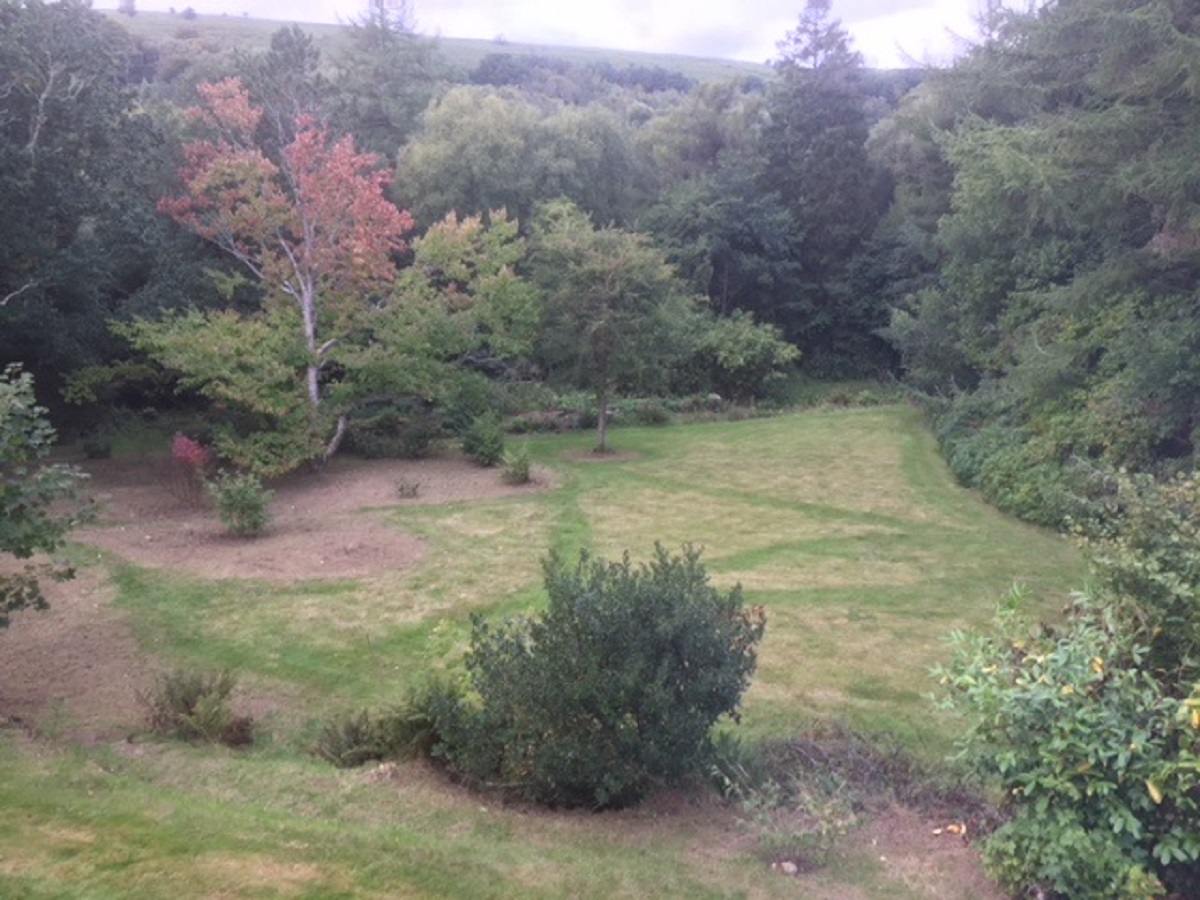
A no longer mowed but left to grow as meadow with mown paths; an ornmamental pond beyond, abandoned to wildlife.
A lawn does not have to be a lawn everywhere. It can become longer grass, cut only occasionally, with paths through it. Areas at the edges can be allowed to grow more freely, bringing in wildlife and reducing work at the same time. I was discussing this with a friend, a fellow garden designer, only yesterday, and he is thinking about allowing his lovely garden to become a wild garden. In some ways it will be a shame; it will certainly be different; the wildlife will be happy and helped. It may even be better. Besides, he’s bound to go on planting stuff — he’s a gardener — interest will not wane.
In larger gardens, it may be possible to draw a new boundary—a smaller, more manageable garden within the old one — and allow the rest to soften into something looser.
Even in smaller spaces, the principle still applies: not every part needs the same level of care.
Planting for ease
Planting plays a large part in all this.
Intricate mixtures of short-lived or demanding plants tend to increase work. Larger groupings, fewer species, and plants well matched to their conditions tend to reduce it.
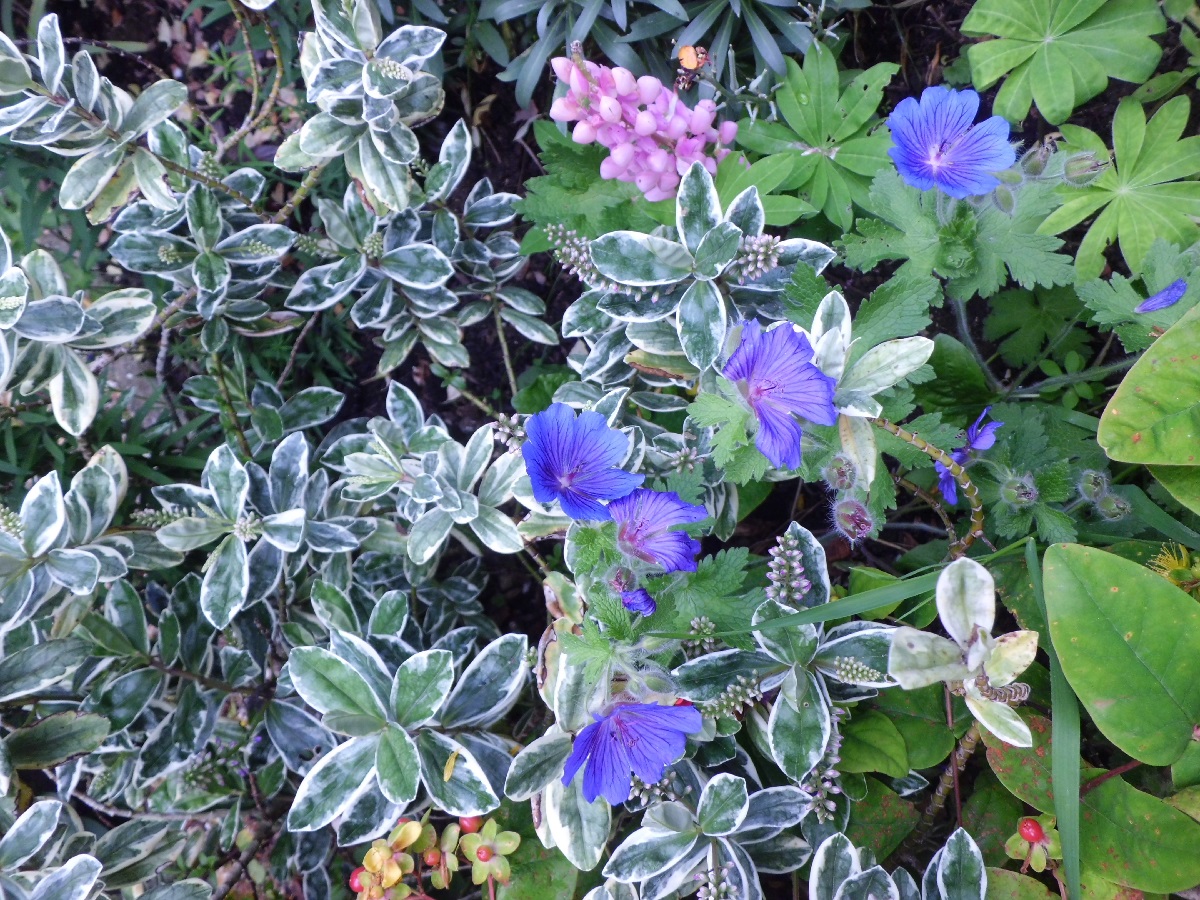
Closeup of effective weed-free ground cover mixed plants
Groundcover can take the place of constant weeding. Shrubs can replace areas of high-maintenance planting. Bulbs can provide seasonal interest without ongoing effort.
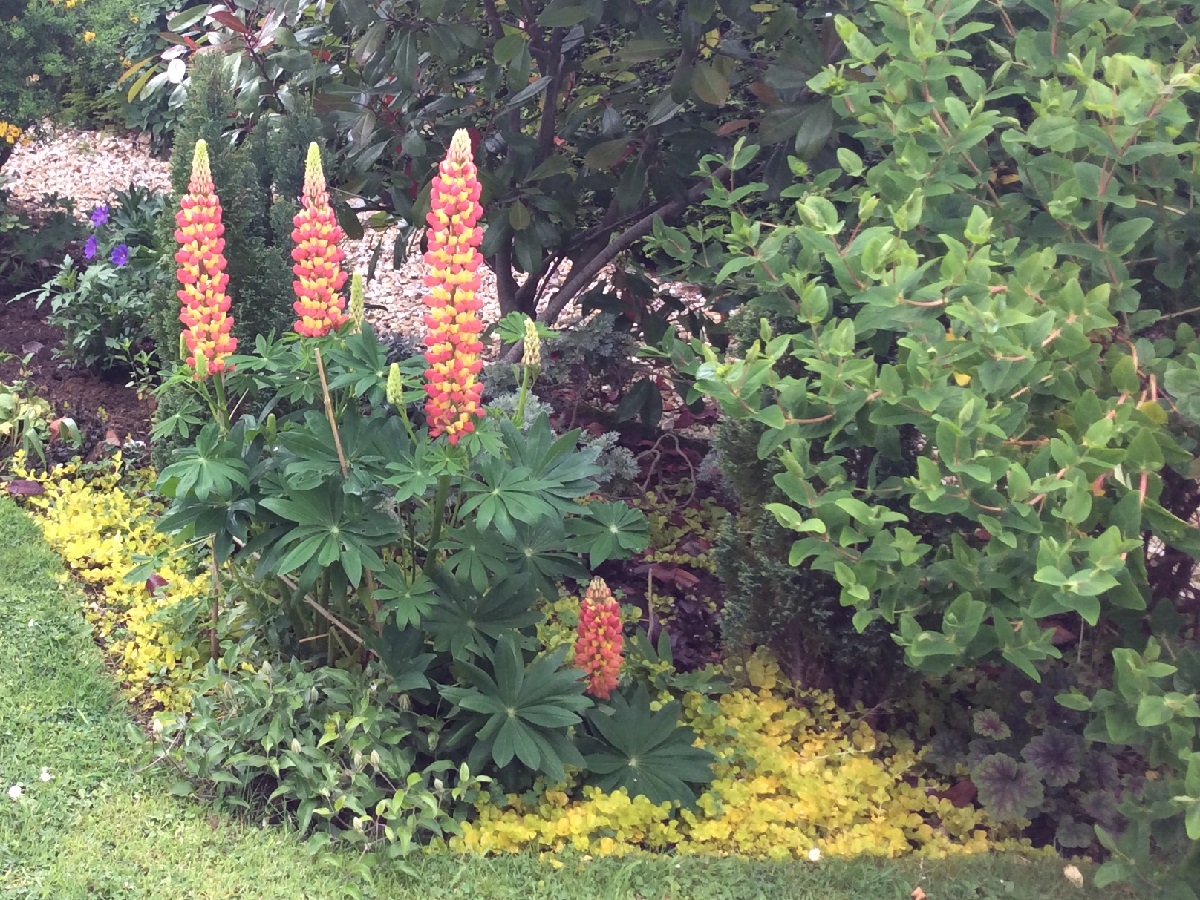
Lychnis nummularia with herbaceous clematis replacing the need for weeding
It is not about making the garden dull. It is about making it sustainable.
A change of emphasis
What emerges from all this is not a diminished garden, but a different one.
Less driven by maintenance, more by structure. Less by effort, more by balance. Still recognisably the same place, but better aligned with the person living in it now.
A different balance
A garden does not have to remain as it was first made.
It can be adjusted, reduced, reshaped. It can be brought back into scale. And in doing so, it often becomes more itself, not less. The aim is no longer to keep up with the garden, but to let the garden sit comfortably within the life around it.
If this is something you are beginning to recognise in your own garden, and would like to think it through, I am always happy to discuss it. Feel free to email me if you like, or leave a comment below.
I will return to this in a later post, with some more practical ways of approaching it.
Each garden finds its own balance in the end. The answer is never quite the same twice.
Leave a Reply