
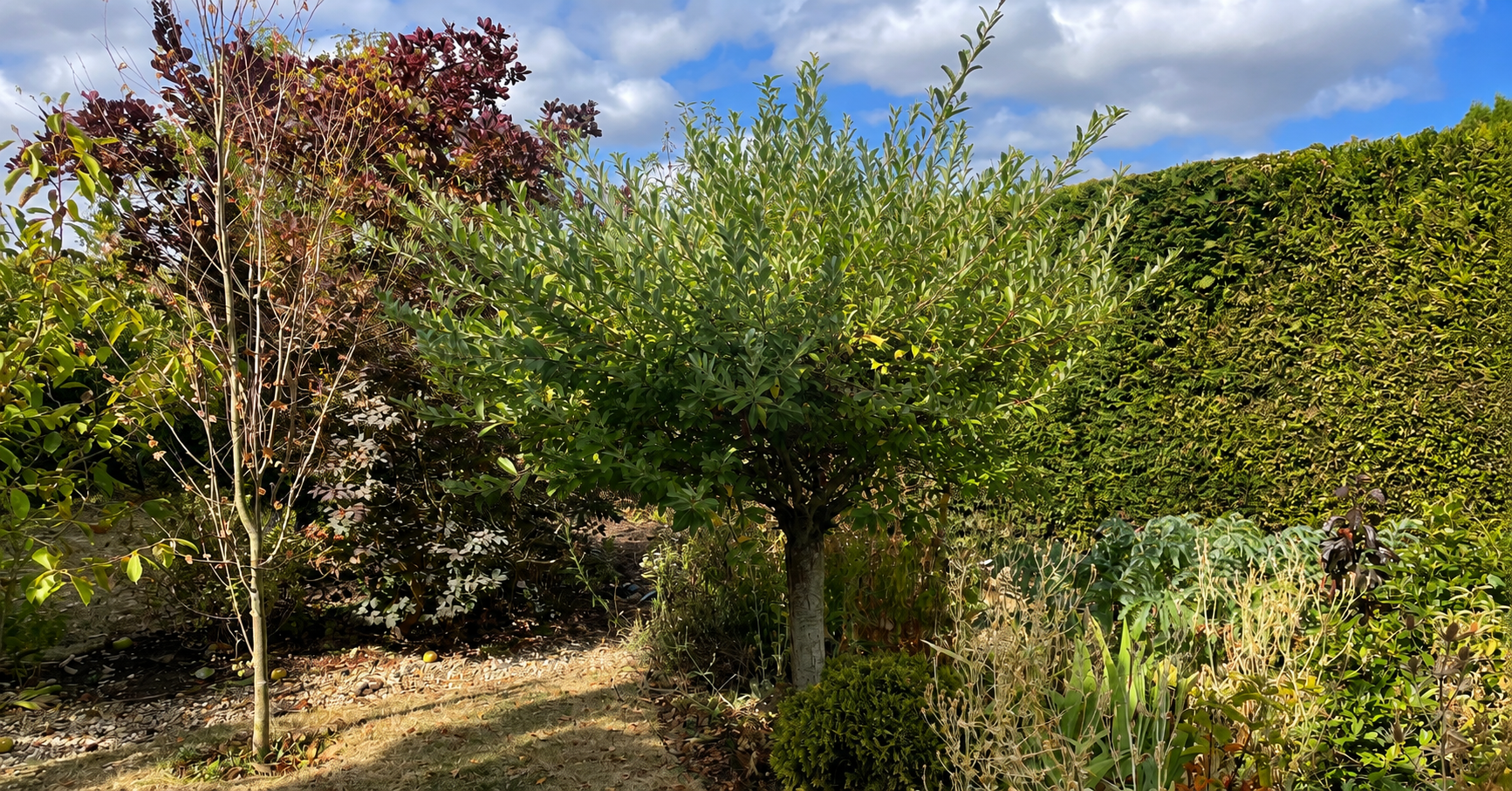
A late-summer border after prolonged drought: some plants still thriving, others plainly struggling.
This is about the plants that not only survive but look good, in summer drought and winter waterlogging. It changed while being written, into a slightly augmented response to the climate-change challenge.
Summer drought is the bigger challenge, because there is little that can be done about it without watering which is expensive if it is allowed at all. Winter waterlogging can be alleviated by having good drainage, and improving the soil condition.
In a post in The Gardener’s Garden, the Facebook group, its leader Jane Schofield said this:
“Thinking of the future… it’s all very well recommending ‘Mediterranean-type’ plants to survive our increasingly drought-stricken summers, but they will be far from happy with wetter winters. In Devon, wet winters are the norm, so my theory is that anything that has survived here this year could be a recommendation for the future.” There are a very few plants that that not only survive these opposite challenges, but look good throughout them, and I list Jane’s plus one or two of mine here.
Plants that cope with summer drought and winter wet and look good
Trees
Ficus carica (fig)
Juglans regia (walnut)
Koelreuteria paniculata (golden rain tree)
Pyrus salicifolia (silver pear)
Quercus robur (pedunculate oak)
Quercus palustris (pin oak)
Quercus bicolor (swamp white oak)
Salix caprea ‘Kilmarnock’
Salix gracilistyla and some more Salix species
Shrubs:
Roses
Buddleia
Buxus
Cotinus
Clematis
Lonicera
Mahonia
Ribes sanguineum
Sambucus
Syringa
Weigela
Herbaceous plants
Achillea ‘Gold Plate’
Aster × frikartii ‘Mönch’
Echinops ritro
Eryngium
Euphorbia characias subsp. wulfenii
Geranium ‘Rozanne’
Geranium ‘Orion’
Geranium macrorrhizum ‘Album’
Melianthus major
The list of shrubs and herbaceous plants doesn’t amount to very many — the looking good stipulation knocks most plants out of it — but a mixed border can look perfectly good with only a few plant species. And it’s important to keep in mind that the list includes only plants that are established. Among the herbaceous plants, there must be many cultivars in addition to those listed; among the achilleas for instance and the hardy geraniums and the euphorbias. And as we all know, what works in one garden doesn’t necessarily work in another. For my own, I am tempted to add Astrantia, but that isn’t for everybody, I know.
There is a design response to the problem which I think helps. We can make the garden as a whole resilient by arranging for different plants to be doing their useful work at different times, roughly spring, summer, and autumn.
First, the spring plants. These exploit the period when the soil still contains winter moisture, they grow and flower, and then retreat before the worst drought arrives. Spring bulbs of course; Anemone blanda is an obvious choice; Corydalis can perform much the same function; Cyclamen coum and subsequent cyclamen performers; Pulmonaria. Another example is Lamprocapnos spectabilis which I still know as Dicentra spectabilis. I am interested to see that Beth Chatto Gardens names Bistorta amplexicaulis [Taurus] (‘Blotau’) as being exceptionally drought tolerant, and it will naturally be happy in wet conditions. But the virtue of these spring garden plants isn’t that they are extraordinarily drought-resistant, but that their season avoids the drought altogether.
Then comes the summer backbone: the plants in Jane’s list and others which really do withstand prolonged dry conditions without collapsing into an eyesore.
There is a third wave, plants which have been quietly building themselves while the summer plants are flowering, and take over towards the end of summer and beyond, plants such as Hylotelephium (Sedum) whose fleshy leaves equip it for drought. Also later Asters, Liriope, Ceratostigma, Salvia ‘Blue Spire’ and S. ‘Perovskia’. This is also the time for grasses like Molinia, Panicum, Deschampsia and some Miscanthus. Anemone x hybrida and related Japanese anemones are perhaps a bit risky; mine this year are beyond hope.
There is a further possibility, which is a deliberate management option for suitable vigorous herbaceous plants. We might think that some plant is growing beautifully in May, so leave it alone and hope for a stunning display on July. But if July is predictably the period when the plant is going to run out of water, scorch and collapse, there isn’t much virtue in encouraging it to produce a large mass of foliage and flower stems immediately beforehand.
Instead, we could apply a modified version of the Chelsea chop, deliberately sacrificing the plant’s early summer performance in order to obtain a better late summer one. This won’t work with everything. Some plants will regenerate enthusiastically after a May cut; others will not flower properly that year, and plants whose crown dislikes being cut or which make only one growth cycle should be left alone.
There is a good deal of research yet to be done to make the best of climate change in the garden. For instance, just how well-established does a plant need to be to survive a long summer drought? And how different is the forecast if the position is sunny or shady? Are there specific cultivars of suitable plants bred specially for both drought and wet? What tap-rooted plants (reaching ground moisture in summer) tolerate winter wet?
Take tap-rooted plants. I thought of foxgloves immediately, but their winter wet tolerance is a bit limited. In shady light soils, they should work well if they have seeded from last season. Asclepias incarnata (swamp milkweed) is said to have a high level of tolerance of summer drought; Hydrangea paniculata is the most drought-tolerant of hydrangeas. In partial shade Ilea virginica should look good.
There are two essentials: first, hardly any plants are drought-tolerant unless their root systems have matured. Until then they need to be watered deeply and thoroughly through their first full summer. Secondly, a thick layer of organic mulch applied in late spring to trap the winter moisture in the soil will delay the onset of summer drought stress.
Climate-resilient gardening isn’t necessarily about keeping cherished plants alive at all costs. Sometimes it means watching what happens, accepting the evidence, and replacing a plant whose conditions have ceased to suit it with one that will flourish without constant intervention.
Leave a Reply