Clematis are often thought difficult because of their pruning rules. In reality the three pruning groups are very simple once the plants are understood.
If in doubt, plant a clematis.
Garden writers have long joked that when a border seems uncertain, the answer is to plant a hardy geranium. The remark is often associated with Margery Fish of East Lambrook Manor in Somerset, and it contains a great deal of truth. Exactly the same could be said with equal force about clematis.
Why clematis seem complicated
Many gardeners approach clematis with hesitation. Let’s first of all dispose of the first thing that comes up: how to pronounce clematis. Some say cleMAYtis; others say cLEMatis. It really couldn’t matter less. I say cLEMatis, my wife insists on cleMAYtis; so as far as I am concerned, that’s all right. Let’s move on.
The catalogues speak of groups of clematis, three pruning regimes, and hundreds of named varieties. It can sound like a subject requiring a small handbook rather than a pair of secateurs. (The handbook does indeed exist. It’s Raymond J. Evison Making the most of Clematis 1979, later published as The Gardeners Guide to Growing Clematis. Both titles are out of print, but seem to be freely available secondhand. I find my 40-year-old copy very useful.)
The simple reality
In reality the genus is much simpler than it appears. Like most plants, clematis make much more sense when one remembers where they come from. Some belong to woodland edges, some to sunny hillsides, others to rocky ground where their roots run deep in crevices. Once the plant’s natural preferences are understood, the supposed complexity begins to dissolve. It becomes simply a matter of right plant, right place. We don’t need to sort clematis into elaborate tables or compile spreadsheets. In theory it’s possible to have one clematis or another in flower every month of the year, especially in the West Country. December, January, or February may require a little luck. Catalogues sometimes divide clematis into many groups, but for practical purposes gardeners need only remember three. Although there are dozens of species and hundreds of cultivars, they can be seen as falling within one of three groups only: ones that flower early on old wood, or flower early and again later, or flower late on new growth. These correspond with the three pruning groups.
Pruning made simple
Group 1 (evergreen and early flowering species)
These include armandii, x cartmanii, cirrhosa, alpina, macropetala, montana and some minor species. Prune after flowering, if at all. (I prune C. montana, but not the others in this group)
Group 2 (repeat flowering Clematis cultivars)
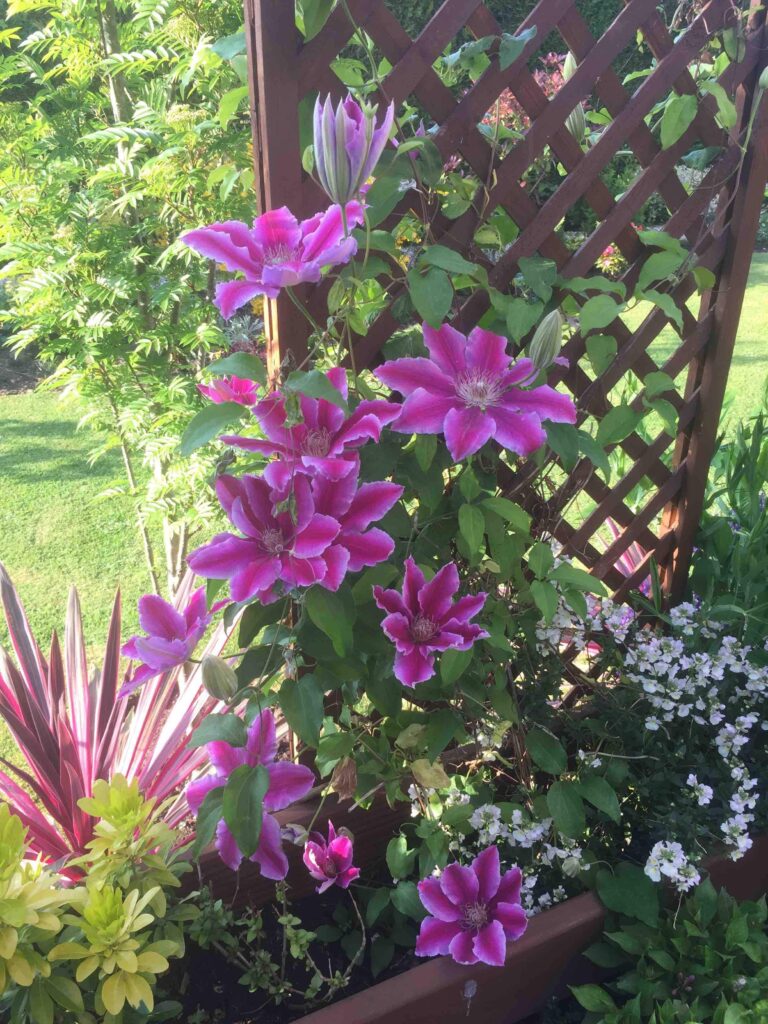
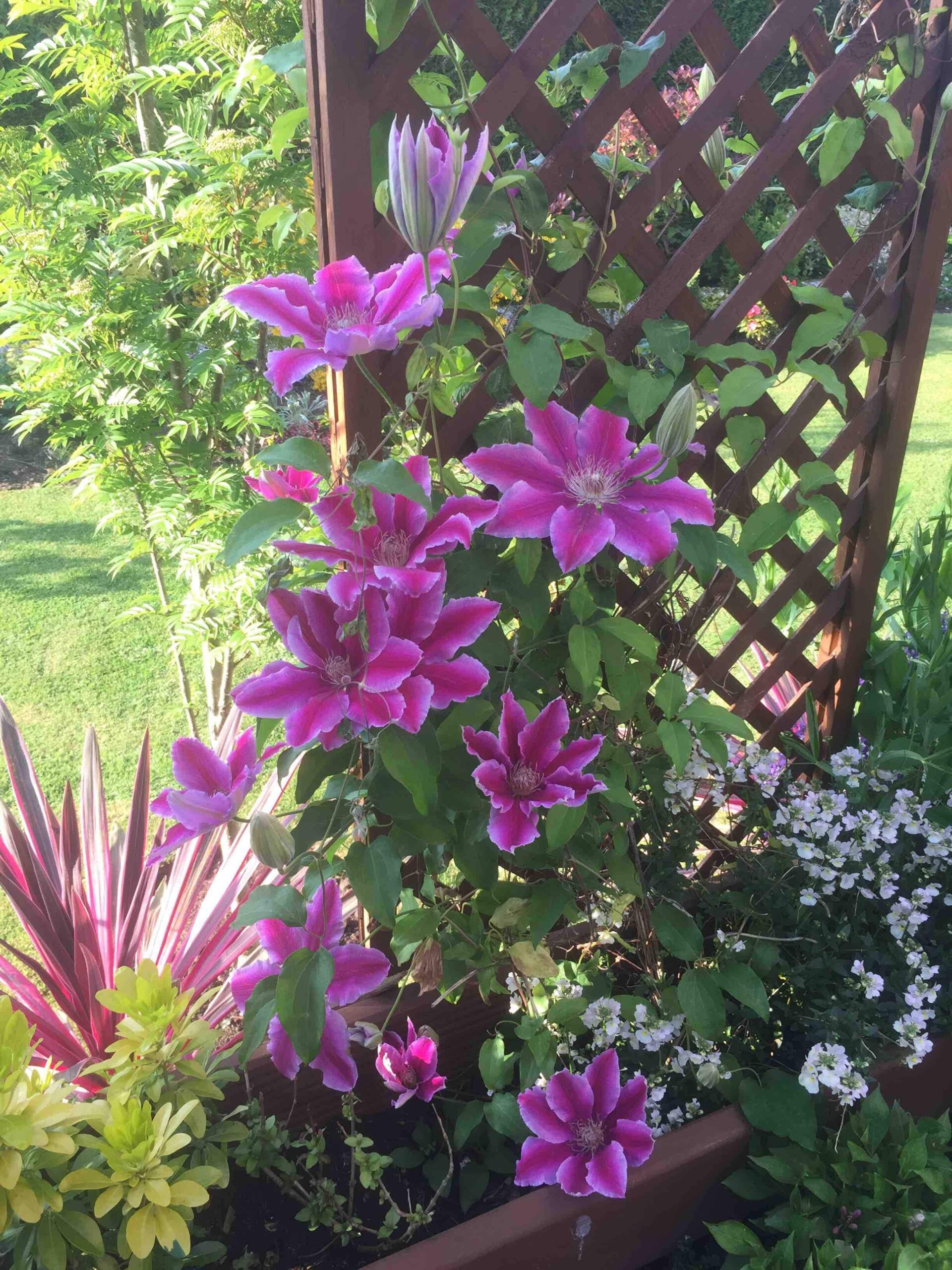
These are the well-known large-flowered hybrids such as ‘Nelly Moser’ and ‘The President’ and ‘Dr Reppel’. They can flower on both old and new wood, so a gentle shortening of stems in late winter is usually enough. The hybrd shown above hown above — ‘Dr Ruppel’ — is a good example of a mid-season, large-flowered type, the kind that causes most of the uncertainty.
Group 3 (late flowering)
These flower from July onwards, and include viticella, and a range of species including the important tangutica and texensis and their cultivars. Cut back hard in winter.
If you forget the rules and prune a clematis at the wrong time, the usual consequence is simply that you lose that year’s flowers. The plant itself will almost always recover perfectly well. And, if you overlook pruning altogether, or forget to do it, clematis will normally forgive you. It probably goes without saying that planting clematis from more than one of these groups in the same place can quickly become a nightmare.
How clematis behave in the garden
When clematis flower
The three very early species need a sheltered site to survive, even in the West Country. Cirrhosa cultivars can be grown in pots, so could be moved indoors for the winter months to be on the safe side. Like most plants that flower in the winter, these species tend to be scented.
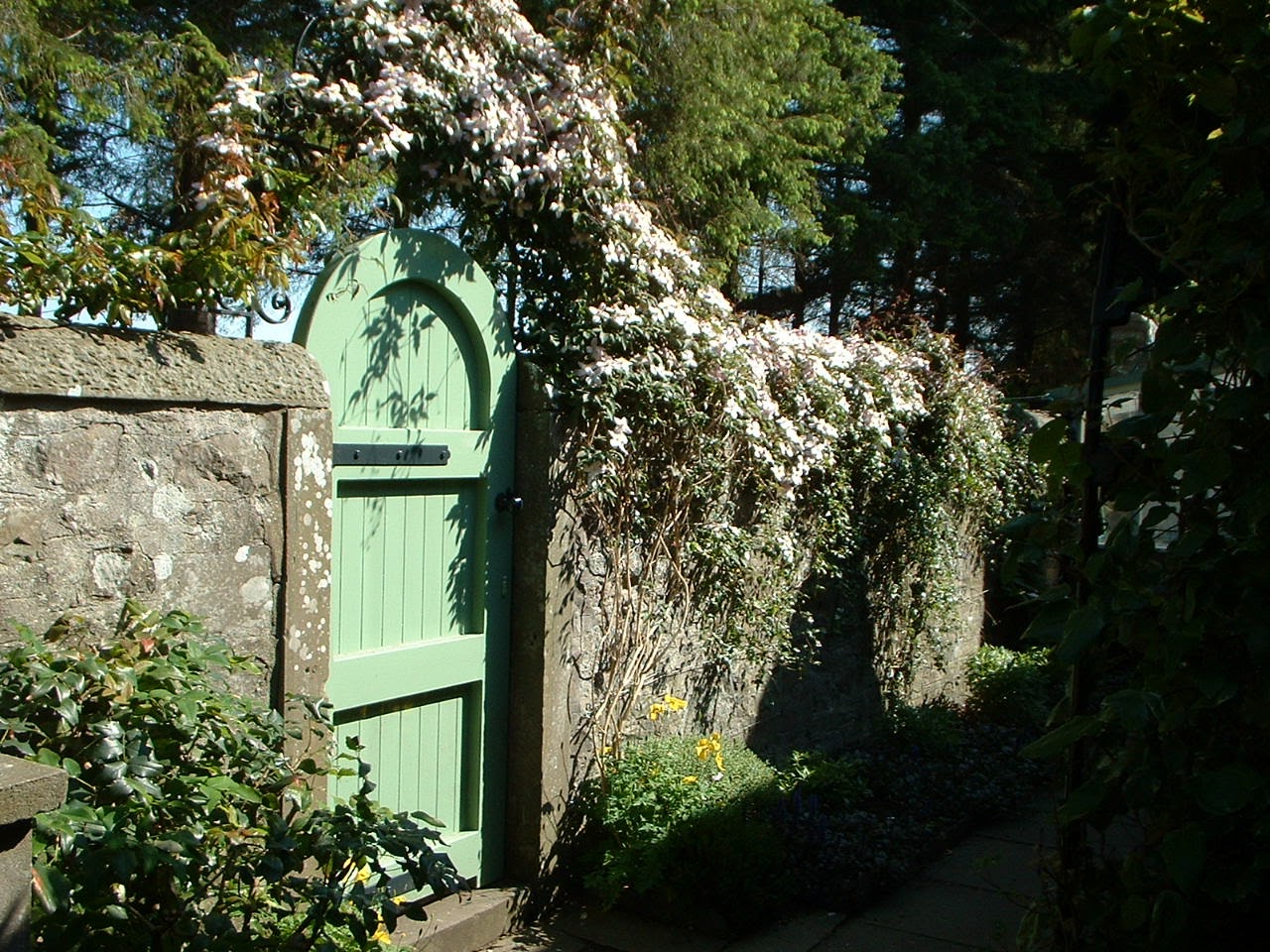
Next to flower are the alpina, macropetala, and montana types, and all of these are entirely hardy. Alpina and macropetala flower in April and May, whilst montana waits until late May or June. Clematis montana ‘Elizabeth'(see image above) is the pale pink-flowered one you see everywhere, very vigorous atop walls and over fences. The more demure C. m. ‘Freda’ is a deeper pink, less often seen but more subtle. I like ‘Freda’ growing through Rosa ‘Albertine’ to provide some interest before the rose blooms. A special favourite is C. m.‘Broughton Star’ which will climb to the eaves of a two storey house, with semi-double flowers of very deep plummy-pink, almost red, and a purply-bronze foliage as the plant matures – grow in a sunny position to enhance the colour of flowers and foliage.
Next after these species come the vast majority of clematis, the hybrids of the genus rather than species. These are big-flowered, abundant and spectacular. Their growing spans take us to September, even October in a few cases. Examples are ‘Nelly Moser’, The President’ ‘Dr Ruppel’ (see the image above), and ‘Niobe’.
After this main group of cultivars, we have the viticella types which flower from late summer through the autumn. The don’t suffer from clematis wilt which is a welcome advantage, and are happy to scramble about though hedges and at ground level. Perhaps more than most clematis, the viticellas work as good companions for other plants, shrubs, and trees. They are happy growing in any position; C. v. ‘Betty Corning’ will even grow willingly in a container. C. ‘Etoile Violette’ is one of the best, its deep purple pairing beautifully with Geranium ‘Rozanne’ or ‘Orion’.
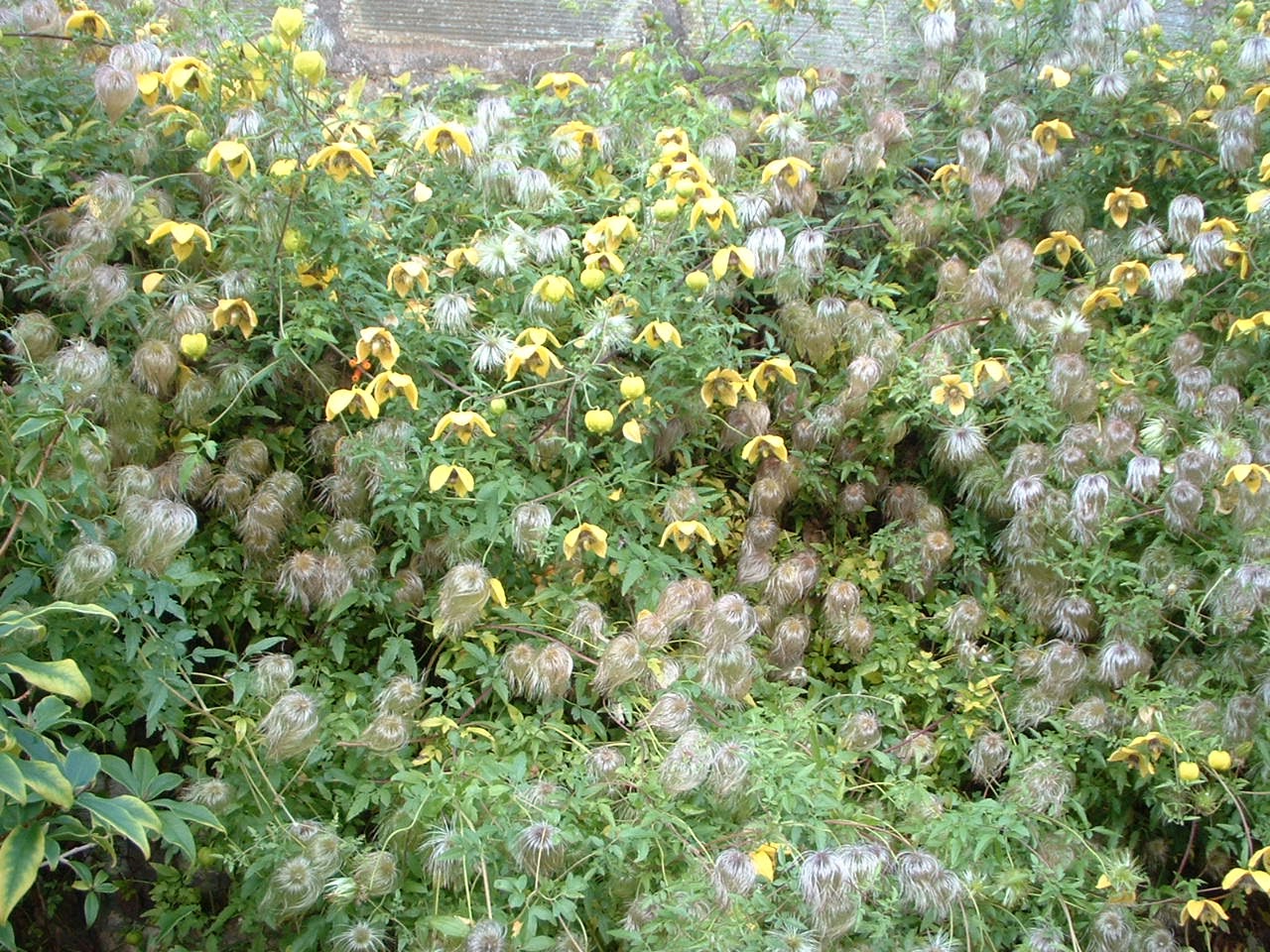
Bringing up the rear is a range of species, of which the most important are C. tangutica and C. texensis. C. tangutica has nodding yellow flowers which last until September. (See the image above.)
Using clematis in planting
Clematis among other plants
The later flowering clematis are perhaps the most interesting from a designing point of view. The earlier ones tend to perform alone, whereas these late flowerers are wonderful in companion planting.
Clematis tangutica
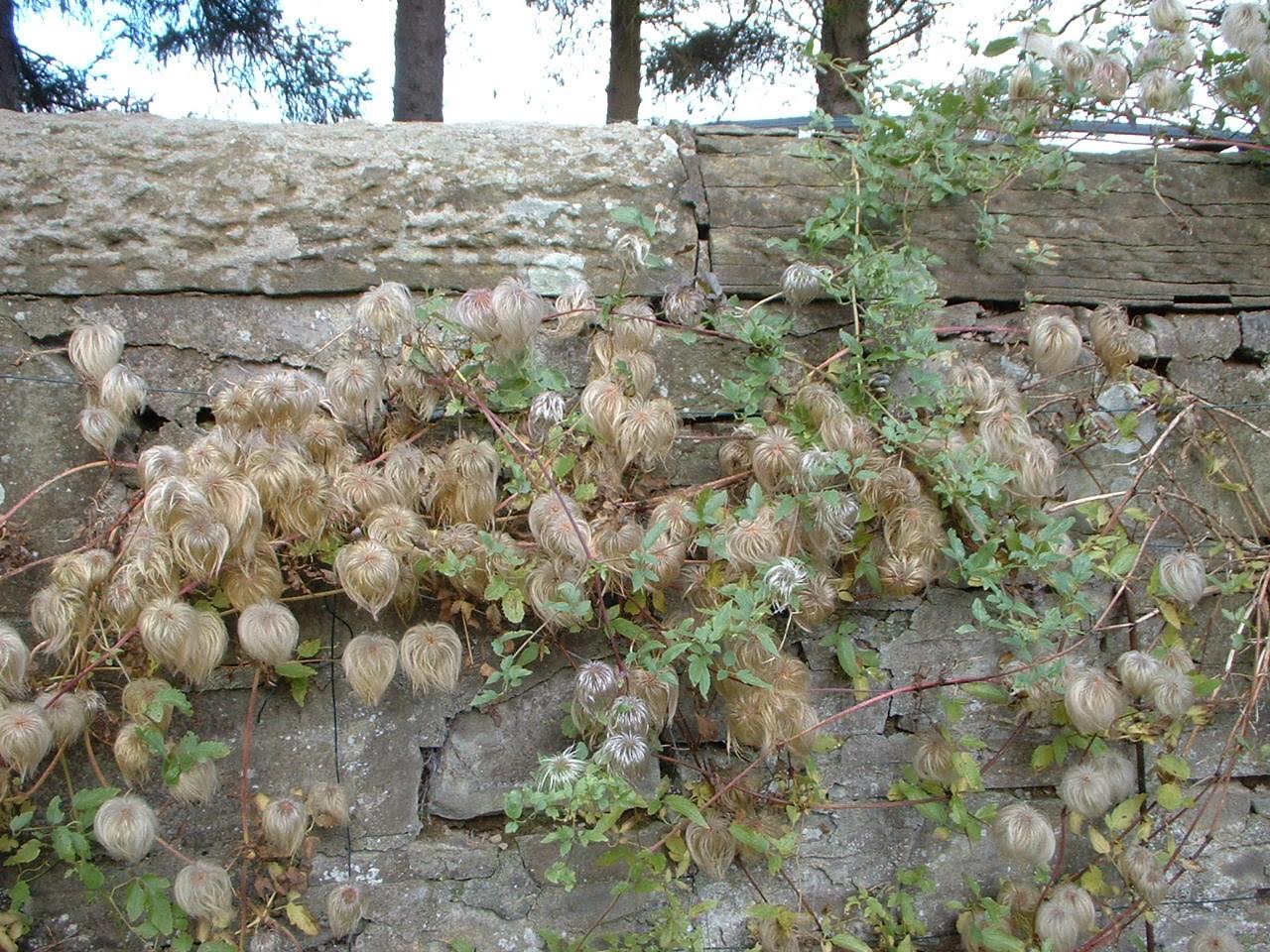
I had Clematis tangutica in Scotland in the most unpromising place imaginable: four feet up a stone wall filled with rubble, where there was neither soil nor root run to speak of. It seemed perfectly content there, which tells you a great deal about the plant. Their season is then extended by pretty seedheads like those of Clematis vitalba (the only clematis native to England, ‘Old Man’s Beard’).
Leave a Reply