
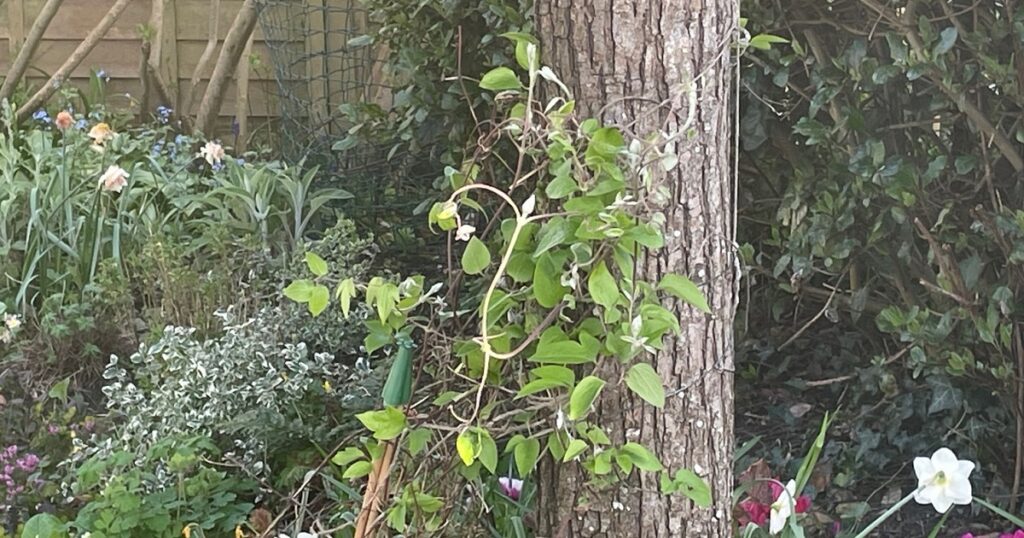
Clematis are often thought of as climbers to be “placed” — against a wall, over an arch, up a trellis. In a garden, they are more interesting than that. They move.
How clematis move
They move visually and physically through the garden: threading, scrambling, leaning, looping, and shifting the eye as they go. They slip between branches, borrow the strength of other plants, and alter the picture from one week to the next. Used well, they do more than flower: they carry the eye and soften the garden’s more rigid lines.
Every cherry needs a clematis
My own first encounter with clematis came more than sixty years ago at Rosemoor. My aunt, Lady Anne Palmer, showed me a cherry tree with a clematis climbing into it, and impressed on me that every cherry she had, or planted, ought to have a clematis in it: otherwise, she felt, an opportunity had been missed. I have never forgotten that, and have done the same ever since.
She was right. Clematis are often at their best not when given a support of their own, but when allowed to move into the branchwork of a small tree or large shrub. They borrow structure, but they also transform it.
A cherry in flower is one thing; a cherry carrying a clematis later in the season is another. The partnership prolongs interest and changes the way planting is seen. The tree provides form and framework; the clematis introduces movement, interruption, and a second season of attention.
Clematis that travel
Some travel. Clematis tangutica may turn up at a distance from where it was planted, as though it had quietly made up its mind to live elsewhere. Clematis vitalba, true to its expansive nature, belongs to that larger category of plants which do not so much stay in gardens as pass through them.
Clematis plant companions
Three “rules”
One firm rule comes first: never plant two different clematis together in the hope of sorting them out later. You won’t. The same goes for clematis of different flowering seasons tangled into the same support. However good the idea might seem at the planting stage, the result is an unmanageable tangle.
Secondly, always plant the tree or shrub — the structural partner — first. Do not introduce the clematis until that partner is well established. It may take years.
Thirdly, don’t feel compelled to grow a clematis up everything that would support one. Many trees and shrubs, particularly when mature, are complete in themselves. Adding a clematis may detract rather than enhance.
That said, clematis are among the most companionable of plants. Their gift is not only to flower, but to borrow structure and give something back in return — contrast, softness, extension of season, or a change in how the planting is read.
Clematis with another climber
Combining a clematis with another climber can work, but it needs restraint. The danger lies in ceasing to know which plant is doing what, and the moment pruning becomes necessary the partnership turns into a problem.
Where it succeeds, it is usually because the two are clearly different in habit, season, or scale. For this reason I tend to avoid the popular pairing of clematis and honeysuckle. It can be made to work, but it is difficult to predict or manage.
Up into trees and threading through shrubs
More often, clematis are happiest when allowed into a shrub or small tree. This is less a matter of combination than of inhabitation. The host plant offers branchwork and framework; the clematis brings movement, interruption, and a second life at another moment in the season.
There is, however, an obvious limitation: trees grow. A clematis that suits a young tree is unlikely to remain effective as it matures. Among conifers, pines are about the only candidates where a clematis — and it would have to be a montana — might work at all. Even then, establishment can be difficult, given the competition for water. In any case, I prefer to leave larger trees unadorned as they mature.
The viticella cultivars work well with Ilex (holly), while Taxus (yew) provides an ideal dark background for them, as well as for C. vitalba (Traveller’s Joy). Among larger evergreens, Eucryphia x nymansensis could carry a montana, perhaps C. montana var. grandiflora, echoing its later white display.
Among deciduous small trees, prunus (not just cherries), sorbus, syringa, and ornamental fruit trees are all suitable for pairing with mid- and late-flowering clematis, avoiding overlap with their own flowering seasons. Dense-canopied trees such as Pyrus salicifolia require a clematis that tolerates shade — ‘Nelly Moser’, ‘Prince Charles’, evergreen species such as armandii or cirrhosa, and the prolific C. viticella ‘Madame Julia Correvon’.
Clematis are not, in general, drought-tolerant (C. tangutica is an exception), so Mediterranean shrubs are not ideal partners because of their differing growing conditions. Most other shrubs, however, can be paired successfully.<
Large shrubs such as rhododendrons benefit particularly, relieved of their long periods of inactivity. Ceanothus, too, can carry a viticella once established.
Among smaller shrubs the possibilities widen considerably. Callicarpa bodinieri ‘Profusion’, for instance, is valued for its autumn berries but ungainly in youth; a clematis can lend it interest during those early years and continue to complement it later. Sophora microphylla, with its early yellow flowers, could take a late-flowering viticella, or an alpina for a softer, earlier contrast.
Pairing with roses
Roses form a category of their own. A clematis can add a second season to a rambler or climber, or lighten the outline of a shrub rose. With hybrid teas, I am more cautious: the effect can be beautiful, but only if the clematis does not obscure the rose’s form or complicate routine care.
This leads to one of the most satisfying combinations: climbing or rambling rose, clematis, and hardy geranium. The rose provides structure, the clematis extends the flowering season, and the geranium acts as a living mulch, suppressing weeds and keeping the roots cool.
A reliable example is C. ‘Étoile Violette’, a vigorous late-flowering viticella with deep purple flowers from July to September. It sits well with a pale climber such as R. ‘Madame Alfred Carrière’ or a rambler like R. ‘Bobby James’, with Geranium ‘Orion’ or ‘Patricia’ below.
Weaving through grasses or looser planting
A different approach is offered by Clematis texensis and the herbaceous clematis. These do not climb in the usual sense, but thread and mingle through neighbouring plants, often needing only the lightest support. They belong naturally to a looser style of planting, where the aim is not display on a structure but movement within the planting itself.
The geographical sources
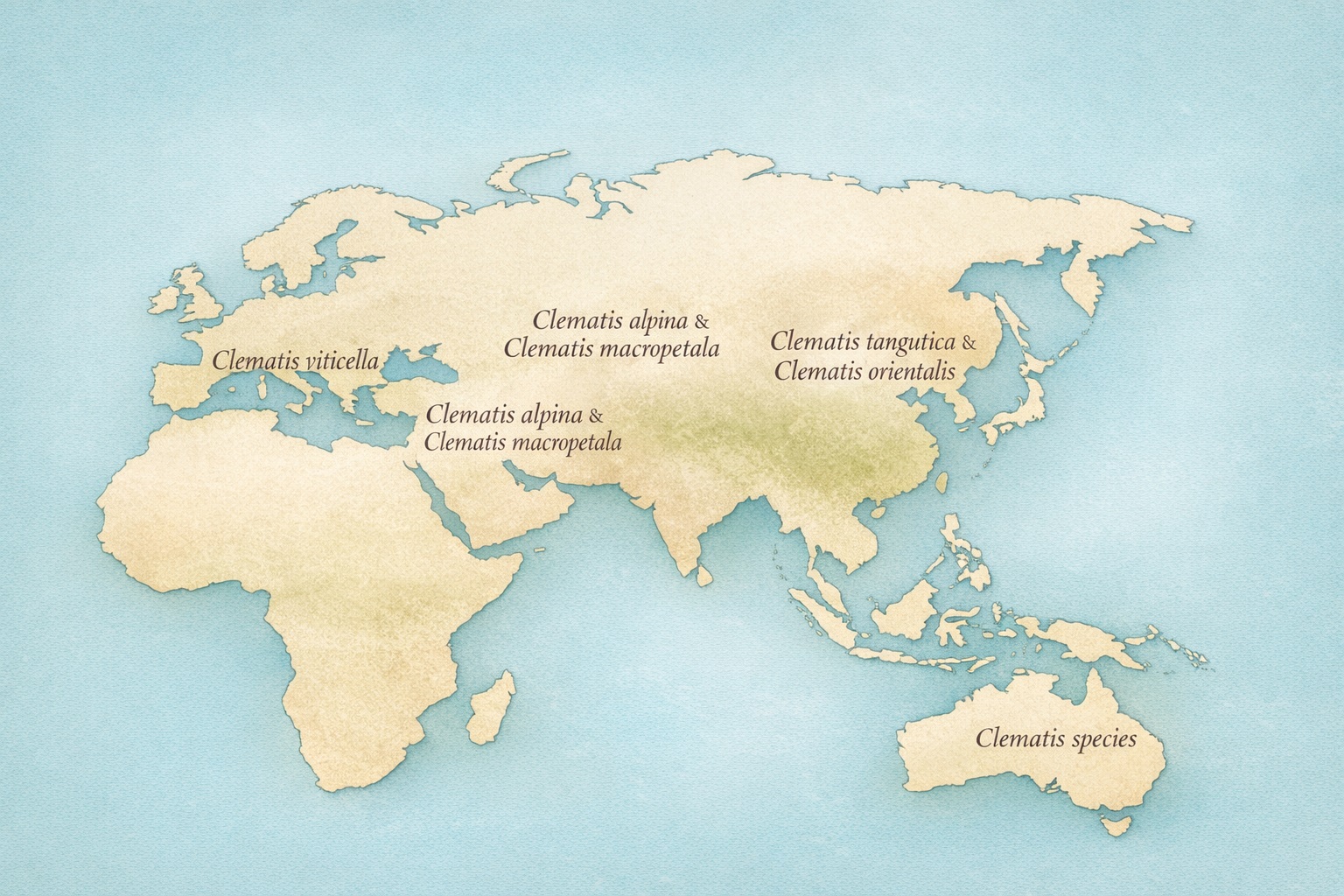
To understand why clematis behave as they do in the garden, it helps to look at where they come from. The map above shows something of that range.
They are not, in origin, a single, uniform group of plants. They come from a wide sweep of Europe and Asia, with each region giving rise to its own kinds of clematis, shaped by climate, soil, and light.
In southern Europe and around the Mediterranean, species such as Clematis viticella grow in open, sunny places, often in dry conditions. These are plants accustomed to heat and exposure, scrambling through shrubs rather than climbing into dense woodland. It is no surprise that they prove among the most reliable in gardens, tolerating poorer soils and brighter positions, and pairing naturally with roses and other sun-loving plants.
Further north and east, in the cooler climates of central and eastern Europe, species such as Clematis alpina and Clematis macropetala belong to woodland edges and mountain regions. Here winters are cold, seasons are shorter, and the light is softer. These clematis are correspondingly hardy, often flowering early, and carrying a lighter, more delicate growth.
Across central Asia, where conditions become more extreme — hot summers, cold winters, and often limited rainfall — species such as Clematis tangutica and Clematis orientalis are adapted to a harsher rhythm. Their toughness shows in their drought tolerance and their ability to seed freely and travel, sometimes appearing at a distance from where they were first planted.
In China and Japan, where many of the garden forms have their origins, clematis are often plants of woodland margins and fertile soils, with summer moisture and seasonal contrast. From here come the ancestors of many of the large-flowered hybrids, with their vigour and generosity, but also their need for good soil and reliable moisture at the root.
There are clematis elsewhere, including in North America, but the plants that have shaped gardens are overwhelmingly those of Europe and Asia.
Seen in this way, clematis are not a single, slightly puzzling group of climbers, but a gathering from different landscapes — each bringing something of its place of origin into the garden.
The history of clematis in gardens
Over time, these different kinds of clematis were brought together — collected, named, and combined — until they became the plants we now grow.
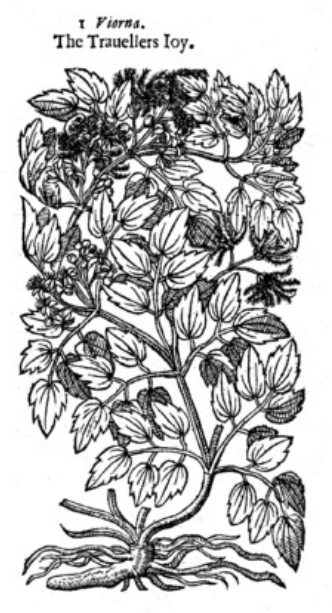
For much of their earlier history, clematis were not garden plants in the modern sense. A few species, such as Clematis vitalba, were familiar enough in the countryside, and that is where the record begins. John Gerard recorded it in his Herbal in 1593: ‘decking and adorning waies and hedges, where people traull; and thereupon I have named it the Traveller’s Joy‘ — but most belonged to distant places and remained unknown outside their native regions. Why ‘waies and hedges’? I remember when I was very young observing how Traveller’s Joy was so abundant beside railway lines. I worked out then what has been since been asserted by recent research, that the constant slipstream of passing trains, probably helped to seed and grow close by.
That began to change from the eighteenth century onwards, as plants were brought back from Europe and, increasingly, from Asia. Among the most significant introductions were those from China and Japan, which would come to shape the future of clematis in gardens.
With these introductions came something new: the possibility not just of growing clematis, but of selecting and improving them. By the nineteenth century, breeders — particularly in Britain and France — had begun to raise hybrids, combining species to produce larger flowers, a wider range of colours, and longer seasons of interest.
In more recent times, this work has continued further east. Poland, in particular, has become a significant centre of clematis breeding, producing a wide range of cultivars noted for their hardiness, colour, and reliability. Many of these have quietly found their way into gardens, extending the tradition of selection and improvement beyond its earlier centres.
Less widely known, but no less significant, is the work taking place in Ukraine. Clematis breeding there has developed its own character, and in recent years has taken on an added resonance. One recent example is Clematis ‘Kiev’, associated with the Ukrainian breeder Alla Olkhovska, whose work with this plant has helped to raise funds in support of Ukraine during the present conflict.
It was at this point that clematis began to take on the character we now recognise: not simply climbers of hedgerow or woodland edge, but cultivated plants with distinct varieties, each selected for particular qualities. In clematis, the nineteenth century belonged to George Jackman and the twentieth to Raymond Evison, both breeders of many cultivars available today.
Many of the large-flowered clematis familiar today trace their origins to this period, especially those derived from East Asian species. They brought with them a new scale of flower and a different kind of presence in the garden — more formal, more showy, and, at times, more demanding.
Alongside them, however, the older species and their simpler descendants have remained. The viticellas, alpinas, and others retain something of their original character: more at ease in the garden, less exacting, and often more in keeping with a natural style of planting. If I had to choose one absolute favourite clematis for use in the greatest range of situations it would have to be Clematis viticella. It epitomises the plant that moves.
Leave a Reply